

AI for business visibility means using AI-powered tools and platforms to help more of the right people find, understand, and trust your business across search, social, and local channels. In an ai business context strategic visibility medium is no longer just your website or one social network, but the full mix of places where AI surfaces your brand as an answer or recommendation.
Learn more about: AI Prompt for Expert Web Design
TL;DR (Quick Summary)
- AI now decides which businesses show up in summaries, recommendations, and voice answers.
- Clear, specific content beats clever slogans in AI-driven discovery.
- Consistent data (name, address, services, reviews) is a major trust signal for AI.
- Local businesses can win by combining AI tools with strong local profiles.
- Start small: fix your basics, then layer AI tools on top of what already works.
How Is AI Changing Business Visibility Today?

Why AI answers matter more than “10 blue links”
AI is changing business visibility by shifting customer discovery from long lists of links to short, confident answers and curated recommendations. In practice, that means a customer might ask a chatbot, a voice assistant, or an AI-enhanced search engine for “the best local plumber” and only see two or three options instead of ten pages of results. According to industry data, more than 50% of online experiences now start with some form of search, and AI is increasingly layered on top of that search behavior.
What this means in a real ai business context strategic visibility medium is that your brand either appears in those shortlists or it doesn’t. Based on experience working with small businesses, the ones that win are not always the ones with the biggest ad budgets, but the ones AI can clearly understand and verify. If your services, location, and proof of quality are easy for a system to read, you stand a much better chance of being surfaced as a recommended option.
Where customers are actually “meeting” your business through AI
Customers now meet your business in places you never log into directly: AI-powered search overviews, map suggestions, auto-complete answers, and even AI-generated comparison tables. A common real-world example is a customer who types a long, detailed question into a search box and receives an AI summary that mentions three providers by name. None of those providers “optimized for AI” in a narrow sense; they simply had clear, consistent signals across the web.
From experience, the most overlooked channels are map listings, review sites, and basic FAQ pages on your own site. AI systems scrape and connect these data points to decide whether you solve the user’s problem reliably. If your information is messy or vague, the system hesitates—and shows someone else instead.
What Practical Steps Help AI Understand and Trust Your Business?
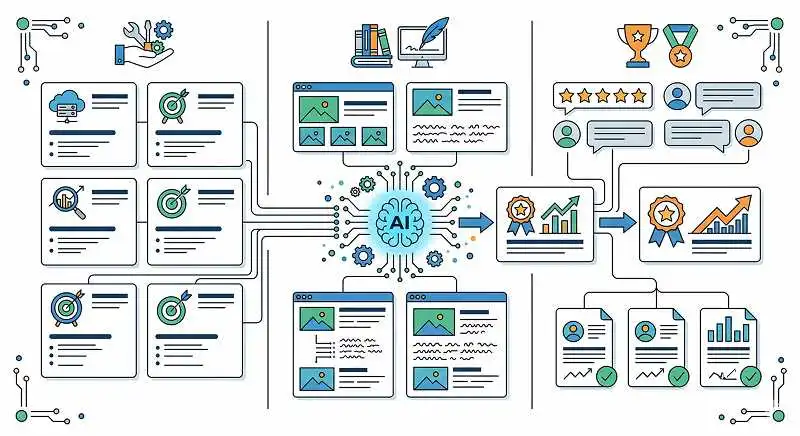
1–3: Clarify your services, content, and proof
The first step is to write painfully clear service descriptions so AI can match you to real-world questions. Describe what you do, who you serve, where you operate, and typical outcomes in simple language, not just brand slogans. For example, “We install and repair residential water heaters in Denver within 48 hours” is far more useful to an AI system than “Your trusted comfort partner.”
Second, build content that answers real customer questions in depth, not just at a surface level. In practice, this means blog posts, guides, and FAQs that cover pricing ranges, timelines, risks, comparisons between options, and local considerations. According to experts in search behavior, these “how, why, and which is better” queries are exactly where AI tends to generate detailed summaries and recommendations.
Third, strengthen your visible proof: reviews, testimonials, case studies, and before–after examples. AI models treat consistent, positive signals across multiple platforms as evidence of reliability. Worth noting, a smaller number of detailed, credible reviews often beats a huge number of vague, low-quality ones, especially for local and specialized services.
4–5: Fix your data foundations and local signals
Clean, consistent business data is a core trust factor for AI systems that aggregate information from many sources. Make sure your name, address, phone number, website, hours, and main services match across Google Business Profile, Apple Maps, Yelp, industry directories, and social profiles. A common mistake I see is slightly different names or outdated phone numbers, which create doubt for both users and machines.
Local signals are especially powerful for small businesses because AI tends to prioritize proximity for service-based searches. Industry standards and experiments show that a complete, active local profile with photos, up-to-date categories, and recent posts often wins against a bigger but less locally tuned competitor. Think of this as the layer where traditional local SEO meets AI-driven discovery.
Which AI Tools and Workflows Actually Improve Visibility?
6: Use AI writing and research tools as assistants, not replacements
AI writing tools can dramatically speed up content creation, but they work best as assistants guided by your real-world expertise. Based on experience, the most effective workflow is: you outline the key points, let AI draft, then you revise heavily to add specific examples, local context, and your actual process. This combination produces content that feels human, yet structured in a way AI discovery systems can easily parse.
Research shows that structured, well-organized pages with headings, clear questions, and direct answers are more likely to be quoted in AI overviews and featured snippets. Use AI tools to help you identify common customer questions, then answer them clearly in your own words. Avoid this common mistake: publishing AI-generated text without editing, which often results in generic content that blends in with everyone else.
7: Monitor, measure, and iterate your AI-driven visibility
Improving visibility in an ai business context strategic visibility medium is not a one-time project; it’s an ongoing feedback loop. Track which pages bring in leads, which questions customers actually ask on calls, and how people say they found you (“Google,” “maps,” “voice search,” “AI summary,” etc.). Even informal tracking in a spreadsheet can reveal patterns within a few months.
Then, adjust your content and profiles based on what you learn. If many customers ask the same question before buying, turn that into a detailed guide or FAQ section. If reviews mention specific strengths—like fast response times or clear explanations—highlight those phrases in your content so AI systems can connect them to relevant queries. Over time, this cycle of listening, updating, and clarifying steadily strengthens your position in AI-powered recommendations.
In summary, AI has added a new layer on top of traditional search and local marketing, where systems choose a small set of “best answers” instead of long lists of options. Small businesses that focus on clarity, consistent data, and real-world proof can compete effectively, even against larger brands. If you start by tightening your basic information, building honest, educational content, and using AI tools to work smarter—not lazier—you’ll turn this shift into an advantage rather than something to fear.
Learn more about: AI Leadership Blind Spots