
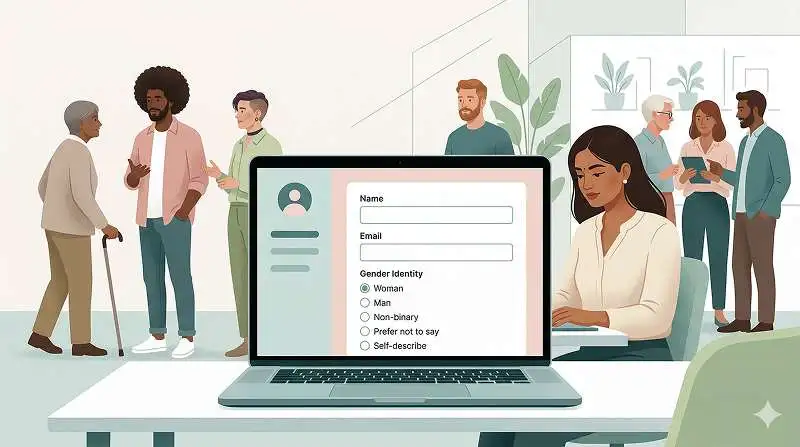
Asking for gender on a form should never be treated as a small detail. A single field can affect whether a user feels seen, respected, and safe enough to continue.
The best way to ask for gender on a form is to first decide whether you truly need the information, explain why you are collecting it, make the question optional, use inclusive language, and give people a respectful way to describe themselves accurately. In most cases, a thoughtful structure works better than a forced binary.
That sounds simple, but many forms still get this wrong.
A gender field is often added by habit. It appears because an older form had it, because a template included it, or because someone assumes it might be useful later. But when a form asks about gender carelessly, it can do more than create minor friction. It can make a person feel misrepresented, excluded, or reduced to a category that does not fit them.
Good forms do more than collect data. They show how a system thinks about people.
That is why asking for gender on a form needs to be handled with care.
Learn more about: What is Human Computer Interaction
Why asking for gender on a form matters
For many teams, this question seems administrative. In practice, it is personal.
A badly designed gender field can remind users that a product, service, or institution was not built with them in mind. Something as small as a dropdown menu can signal whether a form is thoughtful or careless, inclusive or rigid, respectful or dismissive.
This is especially important in digital experiences where the form may be the first direct interaction between a person and a brand, employer, school, healthcare service, or platform. If that first interaction feels narrow or presumptive, trust drops immediately.
So the real question is not just how to ask for gender on a form. It is how to do it in a way that is useful for the organization and respectful to the person answering.
Start with the golden rule: if you do not need it, do not ask
Before debating wording, options, or layout, begin with one question:
Why are we collecting this information?
If the answer is vague, the field probably should not be there.
This is the core rule behind inclusive form design. If you do not need to know someone’s gender, do not ask. Not because gender is unimportant, but because sensitive questions should always have a clear purpose.
There are legitimate reasons to collect gender data. A team might need it for demographic analysis, representation tracking, service personalization, or inclusion reporting. But “we might need it later” is not a strong enough reason for asking about identity.
A good internal check looks like this:
- What exact purpose does this field serve?
- Would anything break if we removed it?
- How will the data be used?
- Can we explain the reason clearly to users?
If your team cannot answer those questions confidently, the most respectful design decision may be to remove the field entirely.
Gender and sex are not the same thing
Another common problem is using sex and gender as though they mean the same thing. In many forms, they are treated as interchangeable. They are not.
In most non-medical contexts, what organizations really want to know is gender, not sex. Gender usually relates more closely to a person’s lived experience, social identity, and how they move through the world. Sex is often framed as biological, though that too is more complex than many forms suggest.
If your form is for a product signup, newsletter, workplace survey, account profile, or customer experience flow, gender is usually the more relevant concept. If the form is clinical or tied to a specific legal requirement, a different approach may be needed.
The important thing is precision. A respectful form should ask for the information it actually needs, not a rough approximation of it.
Sometimes you do not need gender at all
Many forms ask for gender when the real need is something else.
If the purpose is to know how to refer to someone, the better question may be about pronouns, name preference, or how they would like to be addressed. Gender does not automatically tell you that.
For example, if a form only needs communication guidance, these prompts are often more useful:
- What pronouns should we use for you?
- How would you like us to address you?
That is a better design decision because it asks directly for the information the system actually needs. It avoids assumptions, reduces ambiguity, and makes the experience more respectful.
A good form is specific. It does not ask broader identity questions when a narrower practical question would do.
The worst way to ask for gender on a form
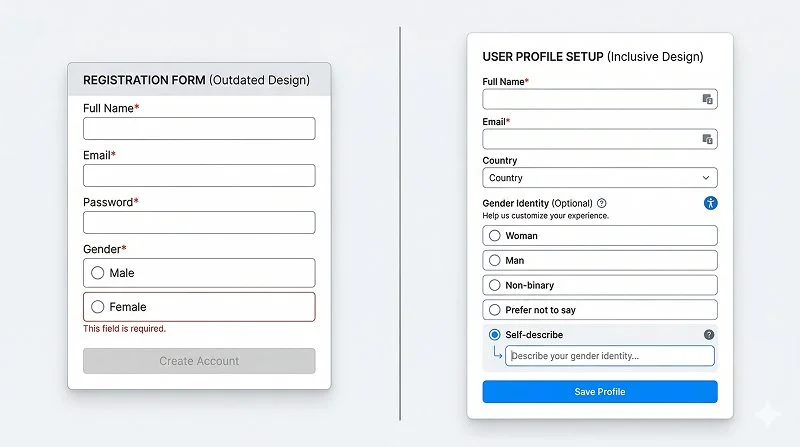
The most common bad example is still everywhere:
- Male
- Female
This structure fails for several reasons.
First, it forces gender into a strict binary. Second, it often uses language people associate more with sex than gender. Third, it excludes people whose identities do not fit those two options. And finally, if the field is required, it pressures users to give an answer that may be inaccurate or uncomfortable.
A field like this may seem efficient, but it is only efficient for the system. It is not respectful to the person.
Bad form design often happens when simplicity is defined only from the database perspective. But a neat database field is not the same thing as a humane user experience.
Make the gender question optional
If you do ask for gender on a form, it should usually be optional.
That means more than removing the required marker. The form should make it clear that declining to answer is an acceptable and supported choice. A visible option such as Prefer not to say often works better than leaving the user to guess whether they can skip the field.
This matters because comfort depends on context. Someone might be willing to share gender in a workplace inclusion survey but not in a checkout flow or public profile form. Another person may feel comfortable answering in one setting and not in another.
A respectful form does not force disclosure. It gives people control.
Use inclusive gender options on forms
If your form genuinely needs gender information, the wording and structure should reflect that gender is not a simple binary.
For many modern forms, a more inclusive approach looks like this:
- Woman
- Man
- Non-binary
- Prefer not to say
- Self-describe: ______
This is not the only correct model, and context always matters. But it is a far better starting point than a forced male/female binary because it balances clarity with flexibility.
It also helps to use gender language carefully. For adults, woman and man are usually better gender terms than female and male in most general-use forms.
This is a small wording change, but it signals a more thoughtful understanding of what is being asked.
Let people describe themselves in their own words
No list will ever cover every identity, every community, or every cultural context. That is why a self-description field can be so important.
A text field gives users room to answer in a way that feels accurate to them. It allows for nuance without forcing the form to become an endless and confusing catalog of labels.
One detail is especially important here: avoid using the word Other.
“Other” may seem like a standard form label, but it carries a social meaning that many users experience negatively. It suggests that some people are standard, while others are an afterthought. Self-describe is clearer and more respectful.
Good forms do not merely add more categories. They leave room for people to define themselves on their own terms.
Do not combine different identity concepts into one field
A common design mistake is trying to fit too much into the gender field.
Gender identity, transgender history, sex assigned at birth, title preference, and pronouns are not all the same thing. When a form mixes them together, it creates confusion and often produces poor-quality data.
For example, adding “transgender” beside “man” and “woman” in one list does not solve the problem. It collapses different dimensions of identity into a single choice and can force people into an inaccurate answer.
If a form has a valid reason to ask about something separate, it should do so separately and with a clear explanation. But most forms do not need that level of detail.
The cleaner principle is this: ask only what is necessary, and ask each thing for its own purpose.
Consider whether users should be able to select more than one option
Not every person experiences identity in a way that fits a single-select structure.
Some users may want to choose a broad category and also provide more detail. Others may use more than one term for themselves. In some research, community, or inclusion contexts, allowing more than one selection can better reflect reality.
This will not be necessary for every form. But it is worth considering if the purpose is to understand people accurately rather than simply force everyone into one narrow bucket.
The system should adapt to reality, not the other way around.
Do not assume everyone has a gender
Inclusive design is not just about adding more labels. It is also about removing assumptions built into the question itself.
Some people do not identify with having a gender at all. That is one reason why the framing of the prompt matters.
A question like Which of the following best describes your gender? is generally better than wording that assumes everyone experiences gender in the same way.
This kind of detail may look minor to the form creator. To the person answering, it can be the difference between feeling recognized and feeling invisible.
Be careful with titles as a proxy for gender
Many forms ask for titles such as Mr, Mrs, Ms, or Miss even when they are not necessary. In practice, title fields are often used as a shortcut for guessing gender or imposing formality where no real need exists.
If your organization does not have a clear operational reason for collecting titles, remove the field.
If there is a genuine reason to include it, use an inclusive approach. That may mean offering a gender-neutral option such as Mx, as well as allowing users to leave the field blank where appropriate.
Respectful form design is not only about adding better options. It is also about removing outdated assumptions.
Explain why you are asking
Users are more likely to answer sensitive questions when the reason is visible and reasonable.
A short line of helper text can make a major difference. For example:
We ask this question to better understand whether our service is reaching people equitably. You can choose not to answer.
That kind of explanation does three things at once. It gives context, reduces suspicion, and signals that the organization has thought carefully about the purpose of the field.
Without that context, even a well-worded question can still feel intrusive.
Privacy and data protection matter as much as wording
Even a perfectly phrased gender question can become harmful if the surrounding data practices are weak.
If you collect gender information, you should know exactly why it is being collected, who can access it, how it will be stored, how long it will be retained, and whether the user has been given a clear reason for sharing it.
Sensitive data should never be collected casually.
This is partly about compliance, but more deeply it is about trust. Users are more likely to engage honestly when a form feels deliberate, transparent, and secure. They are less likely to share identity information when the request seems vague or unnecessary.
A respectful form is not just one with inclusive labels. It is one backed by responsible data handling.
What a good gender field looks like in practice
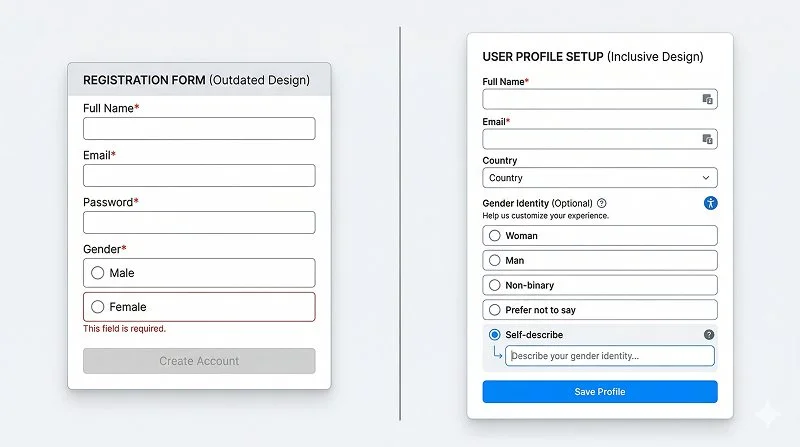
A strong gender question often includes five things:
- A clear reason for asking
- Optional completion
- Inclusive and understandable options
- A respectful self-description field
- Thoughtful privacy practices behind the scenes
In many cases, a practical example might look like this:
Gender (optional)
- Woman
- Man
- Non-binary
- Prefer not to say
- Self-describe: ______
Helper text: We ask this to help improve inclusion and representation in our service. You can skip this question.
This structure is not perfect for every context, but it is a strong, respectful baseline for many general-use forms.
Final thoughts
Asking for gender on a form is not just a content decision or a database decision. It is a decision about how your organization sees people.
The best forms do not ask for more information than they need. They do not confuse categories. They do not force disclosure. And they do not treat identity like a technical inconvenience.
Instead, they make space for complexity without becoming chaotic. They use language carefully. They tell users why the question exists. They offer room to decline. And they recognize that behind every field is a person trying to move through a system with dignity intact.
That is what respectful form design looks like.