

An effective example of the problem statement is a short, precise description of a specific issue, who it affects, and why it matters, written without jumping to solutions. When you learn to write these clearly, you dramatically improve the quality of your decisions, projects, and results at work.
Learn more about: Hierarchical Task Analysis
TL;DR (Quick Summary)
- A problem statement is a concise, solution‑free description of an issue, its impact, and context.
- You should use it before planning solutions, budgets, or timelines—especially for cross‑functional or high‑stakes work.
- A good statement focuses on facts, scope, and stakeholders, not on blame or favorite solutions.
- You can develop one in a few steps: gather data, talk to people, clarify root causes, then synthesize.
- The 7 templates below give you a ready‑to‑use structure for any situation, plus a real example of the problem statement in action for each.
What Is a Problem Statement and Why Does It Matter?
Clear definition (and what it is not)
A problem statement is a focused, factual description of a gap between the current state and the desired state, framed in a way that guides analysis and solution design. It captures what is wrong, for whom, where, and why it matters, without prescribing how to fix it. In real projects, this one page often becomes the anchor that keeps everyone aligned.
An effective example of the problem statement is short (usually 3–8 sentences), specific (with data or observable facts), and neutral (no blame, no pet solutions). It helps managers, individual contributors, and stakeholders quickly understand the core issue so they can prioritize, allocate resources, and collaborate effectively. When done well, it stimulates curiosity and creativity instead of shutting down discussion.
What it is not: it is not a complaint, a wish list, or a disguised solution. Phrases like “we need a new app” or “we must hire more people” are solutions, not problems. According to experts in project management, mixing the two leads to biased decisions and weak alternatives because you lock into one path too early.
Why our instincts make this hard
Our brains are wired to jump to solutions. Under pressure, we default to “Let’s build a dashboard,” “Let’s run a training,” or “Let’s change the tool,” before we fully understand what is broken. Research in decision science shows that premature solutioning is one of the biggest drivers of failed initiatives and rework costs.
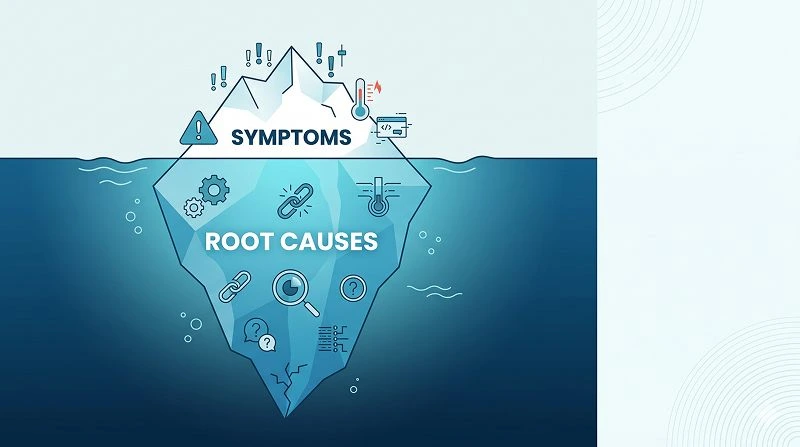
A disciplined problem statement slows us down just enough to see the “iceberg under the water.” The visible symptom (missed deadlines, customer complaints, low engagement) is often only 10% of the issue. The remaining 90%—process gaps, unclear roles, misaligned incentives—stays hidden unless we name the problem precisely. That is why many experienced leaders insist on at least one written example of the problem statement before approving major projects.
When Should You Use a Problem Statement?
Use it before you talk about solutions
You should write a problem statement anytime the issue is complex, cross‑functional, or expensive to address—ideally before you discuss solutions, timelines, or budgets. If you already find yourself debating tools or tactics, hit the brakes and go back to clarifying the problem first.
In practice, I often ask teams a simple question: “Can we write down in three sentences what we are actually solving?” If the room goes quiet or everyone has a different answer, that is a clear sign we need to craft at least one shared example of the problem statement before moving forward.
Common situations where it is essential
Here are typical scenarios where this discipline pays off:
- Writing an executive summary for a proposal or business case
You need to justify why the project exists and what pain it addresses.
- Cross‑functional collaboration (e.g., product, marketing, operations)
Different teams see different parts of the elephant; the statement aligns everyone.
- Defining a customer problem for a product or service
In UX or product management, a clean problem description anchors design and research.
- Process improvement and quality initiatives
Lean, Six Sigma, and similar methods all start with a precise description of the issue.
- Projects that previously failed to get traction
Reframing the problem often reveals why earlier attempts did not work.
- Strategy and planning offsites
Leadership teams use them to focus on the few critical issues instead of chasing symptoms.
- Research or thesis work
Students and analysts need to articulate the research problem before choosing methods.
Red flags that you skipped this step
You can often tell a problem statement is missing (or weak) when:
- Stakeholders argue about priorities but cannot agree on what success looks like.
- The team keeps adding features or tasks without clear rationale.
- People say “It depends who you ask” when you question what the problem actually is.
Whenever you see these patterns, pause and write a shared example of the problem statement to reset the conversation.
How Do You Develop a Strong Problem Statement?
Think of the problem as an iceberg
To write a strong statement, imagine the problem as an iceberg: the visible part is what people complain about, but the mass under the surface is what you must understand. The writing process is really about diving below the surface, then coming back up with a clear, simple description that represents the whole iceberg fairly.
In my experience, the biggest mistake is starting to write too early. The quality of your example of the problem statement depends on the quality of your discovery work. If you skip that, your statement will be vague or biased, and your solutions will miss the mark.
Step‑by‑step process to identify the real issue
Use this practical sequence:
1. Collect data and facts
Pull relevant metrics, logs, customer feedback, or historical records. Look for trends, not just anecdotes.
2. Talk to affected stakeholders
Interview people from different roles and levels. Ask them what they see, how the issue impacts their work, and what they think causes it.
3. Map different perspectives
Write down how each group defines the problem. Notice contradictions and blind spots. This is often where the most valuable insight appears.
4. Probe for root causes
Use simple tools like “5 Whys” or cause‑and‑effect diagrams to move from symptoms (“late deliveries”) to underlying drivers (“unclear handoffs,” “unrealistic promises”).
. Define scope and constraints
Clarify what is in scope, what is out of scope, and any hard constraints (time, budget, regulations).
Only after this should you draft a concise example of the problem statement that synthesizes what you learned. You can then review it with stakeholders and refine until there is broad agreement.
Practical writing guidelines
When you actually write, follow these guidelines:
- Keep it neutral and factual
Avoid blame (“Sales never…”) and exaggeration (“always,” “never,” “everyone”). Use data where possible.
- Separate problem from impact
State what is happening, then describe the consequences (costs, delays, risks, customer pain).
- Avoid embedding solutions
Replace “because we lack a CRM” with “because we do not have a reliable way to track customer interactions.”
- Make it testable
A good example of the problem statement is something you could validate or falsify with data.
- Limit length but not clarity
Aim for a short paragraph or a few bullet sentences, but do not sacrifice necessary context.
What Is a Problem Statement Used For in Real Work?
Value across organizations, teams, and individuals
A problem statement is used to guide decision‑making, align stakeholders, and prioritize resources at every level—from individual contributors to executives and even public policy makers. According to industry standards in project management (like PMI and PRINCE2), a clear description of the problem is a prerequisite for any serious initiative charter.
At the organizational level, leaders use them to justify investments, manage risk, and communicate with boards or investors. At the team level, they anchor sprints, experiments, and improvement cycles. At the individual level, writing a crisp example of the problem statement for your own tasks helps you negotiate scope, push back on vague requests, and focus your effort where it matters most.
Key functions and benefits
Here are the main functions this tool serves:
- Clarifying what really needs to change
It defines the gap between current and desired states in concrete terms.
- Preventing misalignment and scope creep
When everyone agrees on the problem, it is easier to say no to unrelated ideas.
- Improving communication with stakeholders
A short, clear text is easier to share with sponsors, customers, or partners.
- Providing a baseline for measuring success
If you know the starting pain, you can later show how much it improved.
- Stimulating better ideas and innovation
A sharp example of the problem statement invites multiple solution paths instead of locking into one.
- Supporting risk management and prioritization
You can compare problems by impact and urgency, then choose where to act first.
Limitations and caveats
Worth noting: a problem statement is not a silver bullet. It does not replace deeper analysis, nor does it guarantee consensus. Some stakeholders may still disagree with the framing, especially when incentives differ. That is why it is important to treat your first draft as a hypothesis and refine it as you learn more.
Also, in emergencies or very small issues, you may not need a formal write‑up. Use judgment: if the stakes, cost, or complexity are high, invest the time to create at least one well‑crafted example of the problem statement.
What Are 7 Clear Templates and Examples of Problem Statements?
Template 1: Operational efficiency problem
- Template:
“In [area/team], [process/task] currently takes [X time/cost] due to [key cause], resulting in [impact on customers, cost, or quality].”
- Example of the problem statement:
“In our customer support team, resolving billing tickets currently takes an average of 72 hours due to manual data checks across three systems, resulting in delayed refunds and a 15% drop in customer satisfaction scores.”
Template 2: Customer experience problem
- Template:
“[Customer segment] experiences [specific pain] when [situation], which leads to [behavior or negative outcome] and [business impact].”
- Example:
“First‑time users of our mobile app experience confusion when setting up their profiles, which leads to 40% abandoning the process before completion and reduces our ability to convert them into paying customers.”
Template 3: Quality or defect problem
- Template:
“Over the past [time period], the rate of [defect/error] in [product/service] has increased from [baseline] to [current], mainly due to [suspected causes], causing [rework, returns, safety, or compliance issues].”
- Example:
“Over the past six months, the rate of invoice errors in our B2B accounts has increased from 1% to 4%, mainly due to inconsistent data entry rules across regions, causing rework for finance and delayed payments from key clients.”
Template 4: Process or handoff problem
- Template:
“The handoff between [team A] and [team B] for [process] lacks [clarity/tool/standard], leading to [delays, duplication, or confusion] and [quantified impact where possible].”
- Example of the problem statement:
“The handoff between sales and implementation for enterprise clients lacks a standardized checklist, leading to missing requirements, project delays of 2–3 weeks, and strained relationships with new customers.”
Template 5: Strategy or alignment problem
- Template:
“Currently, [group] has no shared understanding of [goal/priority], which results in [conflicting initiatives or metrics] and [wasted resources or missed opportunities].”
- Example:
“Currently, our regional marketing teams have no shared understanding of which customer segments to prioritize, which results in conflicting campaigns, duplicated spend, and inconsistent messaging across channels.”
Template 6: People or capability problem
- Template:
“[Role/team] lacks [specific skill, information, or resource] needed to [desired performance], leading to [errors, delays, or low morale] and [business impact].”
- Example:
“New project managers lack structured training in risk management, leading to inconsistent risk registers, last‑minute firefighting, and an average of 10% budget overruns on mid‑size projects.”
Template 7: Compliance or risk problem
- Template:
“Our current approach to [area] does not meet [standard/regulation/expectation], creating [type of risk] that could result in [fines, reputational damage, or operational disruption].”
- Example of the problem statement:
“Our current data retention practices do not fully meet updated privacy regulations, creating legal and reputational risk that could result in fines and loss of customer trust if audited.”
These 7 templates are not rigid formulas, but they give you a reliable starting point. You can mix elements, adjust wording, and layer in your own data to create a tailored, high‑quality example of the problem statement for any context.
How Can You Start Using Problem Statements Today?
Simple routine to build the habit
To start, pick one real issue you are dealing with this week and write a short example of the problem statement using one of the templates above. Do not worry about perfection; focus on getting something testable and neutral on paper. Then share it with at least one stakeholder and ask, “Does this reflect the problem from your perspective?”
Over time, you can build a personal checklist: Did I separate problem from solution? Did I include impact and scope? Did I use data where possible? This small routine turns into a powerful thinking habit that improves every project you touch.
Connect with broader analysis and research
As your problems become more complex, you may combine problem statements with other tools like process mapping, user research, or market analysis. For instance, once you have a clear description, you might look for existing data, industry benchmarks, or prior studies that illuminate the issue further.
Learn more about: Secondary Market Research
Final thoughts and next step
An effective example of the problem statement is a small investment that prevents large amounts of waste, rework, and frustration. By resisting the urge to jump straight to solutions, you give yourself and your team the space to understand what is really going on—and that is where better ideas, strategies, and designs come from.
Choose one current challenge, write a concise statement using any of the seven templates, and refine it with your stakeholders. Once you see how much clarity this brings, you will find yourself reaching for a problem statement at the start of every meaningful initiative.