

An AI-driven reduced workweek is a way of cutting standard working hours (often to four days) while keeping pay and output the same by using artificial intelligence to automate, streamline, and reprioritize work. Instead of asking people to work harder in less time, it redesigns how work gets done so humans and machines share the load intelligently.
Learn more about: Startup Booted Fundraising Strategy
TL;DR: Key Points
- Use AI to remove low-value, repetitive tasks so people spend more time on deep, revenue-driving work.
- Start with a pilot, define clear KPIs (output, quality, customer experience), and compare data before and after.
- Expect cultural resistance; manage it with transparent communication, training, and a results-over-hours mindset.
- The main business wins are higher productivity per hour, better talent retention, and a stronger employer brand.
- Not every role can move to four days, but most organizations can combine AI and flexible scheduling to reduce overall hours.
What Is an AI-Driven Reduced Workweek, Really?
How does an AI-driven reduced workweek differ from just “working faster”?
An AI-driven reduced workweek is a structured approach where organizations deliberately cut scheduled hours and use AI tools to maintain or increase total output, instead of simply pushing people to work faster. In practice, this means you redesign workflows so software handles repetitive, predictable tasks while humans focus on creative, relational, and judgment-heavy work. The goal is not to squeeze five days of meetings into four, but to remove unnecessary work so fewer hours are genuinely enough.
Based on experience, the biggest mindset shift is moving from “time spent” to “value created” as the main metric. Traditional five-day weeks assume that more hours equal more results, even when a lot of time goes to email ping-pong and manual reporting. With the new model, leaders ask, “What outcomes do we need?” and then design a mix of automation, analytics, and human effort to hit those outcomes in fewer days.
What kinds of work actually change under this model?
In a modern office, AI can draft emails, summarize meetings, generate reports, route support tickets, and even suggest next best actions in sales pipelines. A common real-world example is monthly reporting: what used to take a manager half a day in spreadsheets can be cut to minutes with AI that pulls data, cleans it, and produces a first draft. Another example is customer support, where chatbots handle routine questions so human agents spend their time on complex issues that require empathy and negotiation.
Over time, this changes job descriptions in subtle but important ways. Instead of “collect and prepare data,” analysts are asked to “interpret insights and advise decisions.” Instead of “answer every ticket,” support agents “resolve escalations and improve knowledge bases.” These shifts are how you free up entire days, not just a few scattered hours.
Why Is This Model a Hot Topic Right Now?
What trends are making shorter, AI-enabled weeks more attractive?
This model is hot now because three forces are converging: talent pressure, burnout, and AI maturity. Research from Gallup has shown that employee engagement and wellbeing are tightly linked, and chronic overwork is a major driver of turnover. At the same time, the labor market in many knowledge sectors remains tight, so losing experienced people is expensive and slow to fix.
According to a 2023 survey by 4 Day Week Global, 63% of businesses running a shorter week found it easier to attract and retain talent. In parallel, McKinsey estimates that existing automation technologies could handle tasks equal to 29% of hours worked in the U.S. economy. When you put these together, using AI to cut hours without cutting pay becomes less of a fantasy and more of a practical response to competitive pressure.
Is this still an experiment, or is it becoming standard practice?
Based on what I see in the field, this is moving from experimental perk to emerging competitive advantage. Early adopters were often mission-driven organizations or tech-forward startups willing to experiment with radical flexibility. Now, midsize firms and even conservative industries are testing reduced-hour pilots because they see competitors hiring faster and reporting higher productivity per head.
Worth noting, not every company goes straight to a four-day week across the board. Many start with “No Meeting Fridays,” AI-assisted process overhauls, or reduced hours in specific teams. However, once leaders see that output per hour rises and customer metrics hold steady, the conversation shifts from “Is this safe?” to “Can we afford not to do this while our rivals are?” That’s when it becomes a strategic, not just HR, decision.
How Does an AI-Enabled Shorter Week Work in Practice?
What are the main components that make fewer hours possible?
An AI-enabled shorter week works by combining several components: automation, smart scheduling, predictive analytics, process redesign, and personalization of work. Automation uses tools like AI assistants, RPA (robotic process automation), and chatbots to take over repetitive digital tasks. In practice, that might mean auto-generating proposals from templates, reconciling invoices, or triaging support tickets without human touch.
Smart scheduling uses data to align work with when people and systems are most productive. For example, AI can analyze calendar data and communication patterns to suggest focus blocks, reduce context-switching, and cluster meetings into fewer days. Predictive analytics then forecasts workloads—such as expected ticket volume or sales call demand—so you can staff four days intelligently and avoid bottlenecks that would otherwise spill into a fifth day.
How do process optimization and personalization play into this?
Process optimization is where the biggest gains usually come from, because you question every step instead of simply automating a broken process. In many pilots I’ve seen, teams map a core workflow (like onboarding a client), identify delays and handoffs, and then use AI to streamline approvals, standardize documents, and surface exceptions early. This can cut cycle times by 20–40%, which directly supports shorter weeks without hurting throughput.
Personalization of work means using AI to tailor tasks and schedules to individual strengths and preferences. For instance, some team members may do their best deep work in the morning and their best client calls in the afternoon; scheduling tools can learn this and assign work accordingly. Over time, this reduces burnout and increases output per hour, making it realistic to deliver the same results in four days that used to require five.
Can hours really drop without hurting output?
Yes, hours can drop while output stays flat or rises, but only if leaders treat this as an operating model change, not a perk. When companies simply declare a four-day week without automation or process changes, they usually see stress and hidden overtime spike. The organizations that succeed set clear priorities, ruthlessly cut low-value work, and track key metrics like revenue per employee, cycle time, and customer satisfaction.
In one consulting firm I worked with, automating proposal generation and time tracking freed about 5–7 hours per consultant per week. Combined with better meeting discipline, they were able to close the office every other Friday while maintaining billable hours and client NPS. The math worked because they focused on removing work, not just compressing it.
Learn more about: Major Trends in Technology Togtechify
What Are the Key Benefits for Businesses and Employees?
How does this approach improve business performance?
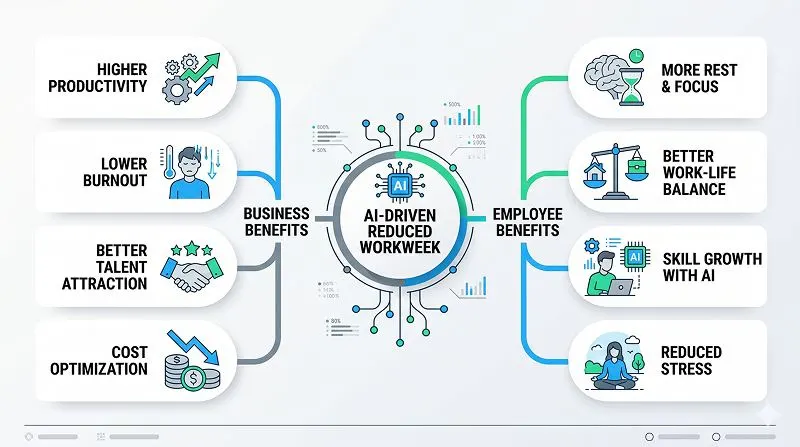
The most direct business benefit is higher productivity per hour, which means you get more output from the same payroll spend. When AI handles routine work, people can spend more time on activities that drive revenue, innovation, or customer loyalty. According to a 2022 Microsoft Work Trend Index, 64% of workers said they struggle to find time and energy for deep work; freeing that capacity shows up quickly in project delivery and quality.
Cost efficiency is another advantage, though it often shows up in indirect ways. You may not immediately reduce headcount, but you can avoid new hires, shorten onboarding, and reduce reliance on expensive contractors. Over time, a reputation for smarter, shorter workweeks also becomes part of your employer brand, lowering recruitment costs and increasing offer acceptance rates.
What’s in it for employees beyond “an extra day off”?
For employees, the benefits center on wellbeing, autonomy, and career sustainability. A shorter, more focused week gives people time for family, health, learning, or side projects without sacrificing income. Research from the UK’s large-scale four-day week pilot showed that 71% of employees reported lower burnout and 39% felt less stressed, while companies reported stable or improved performance.
In practice, I’ve seen teams report that they feel “permission” to say no to non-essential meetings and busywork once a reduced week becomes the norm. This shift in boundaries can improve psychological safety and trust, because leaders are signaling that outcomes matter more than chair time. Over the long run, that tends to reduce turnover and preserve institutional knowledge, which is a hidden but significant financial benefit.
How does this create a competitive edge?
When you combine higher productivity per hour, lower turnover, and stronger employer branding, you get a compound competitive advantage. Your teams can ship features, close deals, or deliver services at a pace rivals struggle to match, even if they work longer hours. At the same time, you become more attractive to top candidates who have options and care about work-life balance.
According to experts in organizational design, companies that align incentives, technology, and culture around outcomes tend to adapt faster to market shifts. An AI-enabled shorter week is essentially a forcing function for this alignment. It pushes you to clarify priorities, modernize systems, and build a healthier social contract with your workforce, all of which make the business more resilient.
What Are the Biggest Roadblocks, and Who Is This Best For?
What common obstacles do leaders face when trying this?
The most common roadblocks are fear of lost productivity, customer expectations, legacy systems, and management resistance. Many executives worry that clients will balk if they hear “we’re closed on Fridays,” even though service levels can be maintained with staggered schedules and automation. Legacy tools and fragmented data also make it harder to deploy AI effectively, leading to skepticism when early experiments under-deliver.
Based on experience, another major barrier is middle management, especially in organizations where “being seen” has long been a proxy for performance. If managers are not trained and supported to lead by outcomes, they may quietly encourage after-hours work or resist process changes. Addressing these concerns openly, and tying leadership incentives to successful adoption, is critical.
How can organizations practically overcome these challenges?
To overcome these roadblocks, start by defining clear KPIs and baselines before you change anything. Measure things like throughput, error rates, customer satisfaction, and employee engagement so you can compare before and after. This data-driven approach reduces emotional debates and helps you adjust the model instead of abandoning it at the first bump.
Next, invest in change management: communicate the “why,” involve employees in redesigning workflows, and provide training on new tools. A phased rollout—starting with one department or one day per month—lets you learn cheaply and build internal case studies. Above all, shift your culture to one that rewards hitting targets and improving processes, not simply working long hours.
Which types of businesses are the best candidates?
The approach works best for knowledge-intensive sectors like software, marketing, consulting, professional services, and many corporate functions (finance, HR, legal) inside larger firms. These environments have a high proportion of computer-based, repeatable tasks that AI can assist with or automate. They also tend to have measurable outputs—campaigns launched, cases closed, projects delivered—that you can track against time.
Industries with 24/7 operations or heavy physical work, such as healthcare, logistics, or manufacturing, can still benefit but usually need hybrid models. That might mean AI-optimized shift patterns, reduced administrative hours, or shorter weeks for back-office teams while frontline coverage remains full. The key is to tailor the model to the realities of your service commitments and regulatory environment.
Learn more about: AI Transformation is a Problem of Governance
How Do You Pilot an AI-Driven Reduced Workweek Successfully?
What are the first concrete steps to get started?
To pilot this model, start by identifying one team or process where work is relatively standardized, digital, and measurable. Map out the current workflow, including tools used, handoffs, and typical cycle times. Then, pinpoint specific tasks that are repetitive and rule-based enough for AI or automation tools to handle, such as data entry, standard email responses, or report generation.
Once you have this map, choose 2–3 AI tools that fit your environment, ideally ones that integrate with your existing systems. For example, you might use an AI writing assistant for customer emails, an automation platform for moving data between apps, and a scheduling optimizer for meetings. Run a short proof of concept focused solely on efficiency and quality, without changing work hours yet, to build confidence and gather data.
How do you structure the actual reduced-hours pilot?
After you see clear time savings and stable quality, design a time-bound pilot—often 8–12 weeks—where the team formally reduces hours. Common patterns include a four-day week, every other Friday off, or shorter daily hours with clear “no meeting” blocks. Define success metrics in advance, such as maintaining output levels, keeping customer satisfaction within a target range, and improving employee wellbeing scores.
Communication is crucial: explain to internal stakeholders and key customers what you’re testing, why, and how you’ll keep service levels stable. During the pilot, hold brief weekly retrospectives to surface issues, such as bottlenecks or unexpected workload spikes, and adjust processes or staffing as needed. At the end, compare the data to your baseline and decide whether to extend, scale, or redesign the approach.
What should you watch out for during the pilot?
Avoid the common mistake of letting “unofficial” overtime creep back in, which hides problems instead of solving them. Encourage employees to log actual hours honestly and make it safe to say when the workload is not realistic. If people are quietly working Fridays to keep up, you need to cut more low-value work or add automation, not declare the pilot a success.
Also pay attention to equity and inclusion. Make sure reduced hours and AI support are available across demographics and not just to favored teams or high performers. If some roles truly cannot reduce hours due to business constraints, consider other forms of flexibility or compensation so the model does not create resentment.