
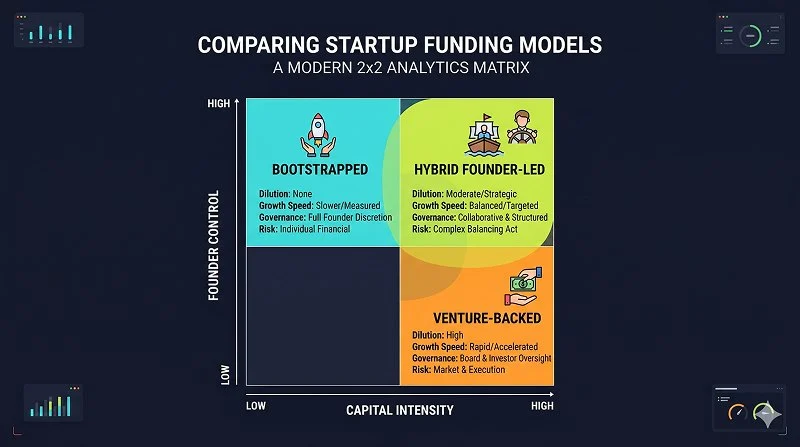
Founder-led fundraising is when the founding team directly leads the capital raise, sets the narrative, and controls the process instead of outsourcing it to bankers, advisors, or dominant VCs. A startup booted fundraising strategy takes this further by prioritizing revenue, selective capital, and control so you can raise money without turning your company into a VC-driven rocket ship.
Learn more about: Ai-driven Reduced Workweek
TL;DR — Key Takeaways
- Founder-led fundraising is hard because you must be CEO, CFO, and head of sales to investors at the same time.
- A “booted” approach sits between pure bootstrapping and classic VC, giving you capital leverage without losing control.
- Most early founders fail not on the pitch deck, but on positioning, targeting, and process discipline.
- This hybrid model works best once you have some traction, a clear business model, and moderate—not massive—capital needs.
- You can systematize the raise with a clear narrative, tight investor list, and a time-boxed process so you stay in control instead of chasing VCs.
What Makes Founder-Led Fundraising So Difficult in Practice?
Why does founder-led fundraising feel like a second full-time job?
Founder-led fundraising is hard because you are selling an intangible future while still running the present-day business. In practice, that means you are context-switching between managing burn, leading the team, closing customers, and persuading investors that the next 18–36 months are worth betting on. Most founders underestimate the emotional load of constant rejection, long feedback cycles, and the pressure to sound confident while still figuring things out.
Based on experience, the real friction usually comes from three gaps: unclear positioning, inconsistent story, and a messy outreach process. Without a tight narrative, every investor meeting feels like starting from scratch, and you end up “just chatting” instead of advancing a structured raise. This is why even great products can languish in fundraising limbo for months.
What are the specific skills founders need but rarely have on day one?
Founder-led fundraising demands skills that are adjacent to, but not the same as, building product or closing customers. You need capital strategy (how much, when, from whom), financial storytelling (translating messy early metrics into a coherent model), and investor sales (running a pipeline, handling objections, and creating urgency). Most first-time founders have never built an investor pipeline or managed a staged close, so they default to scattered introductions and hope.
According to industry data, only a minority of seed pitches convert to checks, even in warm networks. The founders who win usually treat fundraising like a structured sales process: defined ICP (ideal investor profile), a repeatable pitch, and clear next steps after every call. Without these, founder-led fundraising quickly becomes a demoralizing series of coffee meetings instead of a controlled campaign.
How does emotional and psychological pressure affect the process?
The psychological side is often the hardest part of founder-led fundraising. You are tying your personal credibility, years of work, and your team’s future to a yes/no decision from people who see dozens of pitches a week. Every “not now” can feel like a verdict on your worth, which tempts you to change the story too often or chase any investor who shows the slightest interest.
A common real-world example is the founder who extends their round for months because they are afraid to hear a final no. That limbo drains team morale, slows execution, and can hurt customer focus. A disciplined approach forces you to define a fundraising window, accept that many investors will pass, and keep building the business regardless of the outcome.
What Is a Startup Booted Fundraising Strategy, Exactly?
How does this approach sit between bootstrapping and classic VC?
A startup booted fundraising strategy is a hybrid model that sits between pure bootstrapping (no outside capital) and traditional venture-backed growth (raise big, grow at all costs). In this model, you use customer revenue and lean operations as your foundation, then layer in targeted capital to accelerate specific milestones. The goal is leverage, not dependency: money amplifies what is already working instead of compensating for what is missing.
This approach assumes that traction and control matter as much as runway. You still care about valuation and dilution, but you care even more about optionality—your ability to choose whether to raise again, when, and on what terms. That is a very different mindset from “raise every 18 months because that is what everyone does.”
How does it differ from pure bootstrapping?
Bootstrapping means you rely almost entirely on internal resources: founder savings, early customers, and tight cost discipline. The upside is obvious: maximum control, no board pressure, and 100% of the equity remains with the founding team. The downside is also clear: growth is constrained by cash flow, and you may miss time-sensitive opportunities or get outpaced by better-funded competitors.
In practice, many “bootstrapped” companies quietly tap credit lines, revenue-based financing, or small angel checks to smooth cash cycles. A structured hybrid model simply makes that intentional: you decide where a dollar of outside capital creates the most leverage—like accelerating sales hires after product-market fit—rather than treating all fundraising as a binary yes/no.
How does it avoid the worst parts of traditional VC fundraising?
Classic VC fundraising often comes with aggressive growth expectations, board control, and a narrow definition of success (large exit in 7–10 years). That can work well for network-effect businesses or massive markets, but it can distort incentives for companies better suited to sustainable growth. Founders can feel forced into premature scaling, bloated burn, or risky bets to “swing for the fences.”
A hybrid, founder-led model deliberately limits how much and from whom you raise. You prioritize investors who align with your time horizon and risk profile, and you structure rounds that keep you in control of the board and major decisions. Worth noting: this does not mean you avoid VCs entirely; it means you avoid letting any single investor dictate the entire trajectory of the company.
How Do Bootstrapped and Venture-Backed Models Really Compare?
What are the core trade-offs between the two extremes?
Bootstrapped and venture-backed models differ most on control, speed, and risk concentration. Bootstrapped companies grow at the pace of their revenue and cash flow, which usually means slower but more controlled progress. Venture-backed startups trade equity and some control for a shot at outsized, faster growth, accepting higher burn and a narrower path to “acceptable” outcomes.
According to experts, neither path is universally better; each serves different business models and founder goals. Capital-intensive plays, winner-take-most markets, and deep tech often need large VC checks to be viable. Service-light, recurring revenue businesses can often thrive with far less capital if they are disciplined about focus and unit economics.
How do the models differ on key dimensions like control and capital?
Here is a simple way to compare key differences:
- Control: Bootstrapped founders retain full decision-making; venture-backed founders share control with investors and a board.
- Capital availability: Bootstrapped companies rely on revenue and small instruments; venture-backed companies access larger, staged rounds.
- Growth speed: Bootstrapped growth tracks customer demand; venture-backed growth is often pushed faster than organic demand.
- Equity dilution: Bootstrapped paths keep most equity with founders; venture-backed paths typically dilute founders 20–30% per major round.
In practice, many successful companies blend these over time—starting lean, raising selectively, then choosing whether to go “full VC” later. The mistake is locking into a high-burn, high-dilution path before you truly understand your market and economics.
Where does the hybrid, founder-led model outperform?
A founder-led hybrid model often outperforms in markets where speed matters, but not at all costs. For example, a B2B SaaS company with strong retention and clear unit economics can use modest capital to pull forward sales hiring or product expansion, then let recurring revenue compound. You get much of the growth benefit of funding without fully surrendering control.
Based on experience, this works especially well when founders treat investors as leverage, not lifelines. You raise to accelerate validated bets, not to fund experiments you could not justify with your own money. That discipline tends to attract better-aligned investors and leads to cleaner cap tables over time.
How Do You Actually Run a Founder-Led, Hybrid Raise Step by Step?
How should founders design the strategy before sending a single deck?
You should design the capital plan before you design the pitch deck. That means clarifying why you are raising, how much you truly need, and what specific milestones that capital will fund. A simple rule of thumb is to map 18–24 months of runway tied to 2–3 concrete milestones (for example, “reach $1M ARR,” “launch in two new geographies,” or “hit profitability”).
Once you know the “why” and “how much,” you can choose the right instruments: angels, smaller funds, strategic investors, or non-dilutive options like revenue-based financing. Avoid this common mistake: raising a generic “seed” or “Series A” just because that is the stage label everyone else uses. Investors respond better to a clearly articulated capital plan than to a vague “we are raising because it is time.”
How do you craft and test the narrative without overfitting to one investor?
Your narrative should explain three things clearly: the problem, why now, and why you are uniquely positioned to win. You then tie that to traction (what you have already proven) and a capital-efficient path forward (how new money turns into value). In founder-led fundraising, the founder is the chief storyteller; you cannot outsource this to a banker or advisor and expect it to land.
In practice, you should test your story with a few friendly investors or operators before going broad. The key is to refine for clarity, not to contort your business to fit one investor’s thesis. If your narrative changes dramatically from meeting to meeting, it signals you do not yet have conviction—which makes it harder for serious investors to develop theirs.
How do you run a disciplined investor process without losing focus on the business?
Treat your raise like a sales sprint, not an endless trickle of meetings. Build a targeted list of 30–80 investors who fit your stage, sector, and check size, then batch outreach into a defined 4–8 week window. This creates natural momentum, allows you to compare feedback across investors, and increases the chance of overlapping term sheets.
Operationally, assign clear calendar blocks for fundraising and protect time for running the business. Many founders I have worked with set two to three days per week as “investor-heavy” and preserve the rest for product and team. A simple CRM (even a spreadsheet) to track stages, notes, and next steps is often the difference between a controlled process and a chaotic one.
Learn more about: Major Trends in Technology Togtechify
When Does a Startup Booted Fundraising Strategy Actually Make Sense?

What conditions make this hybrid approach the right fit?
This hybrid approach is not for idea-stage founders with no product and no market validation. It works best when you already have some traction—paying customers, engaged users, or at least strong pilot results—and you do not need tens of millions of dollars to prove the model. The more your business can self-fund part of its growth, the more leverage you have in negotiations.
You should also have a clear personal goal: do you want to build a durable, cash-generating company, or are you aiming for a massive exit at all costs? A controlled, founder-led strategy aligns better with the first scenario, or with founders who want optionality between the two. If your only acceptable outcome is a billion-dollar exit, classic VC might be more appropriate.
What are the concrete signals that you are ready?
A common real-world example of readiness is a SaaS startup at $20–50k MRR with low churn and a repeatable sales motion. At that stage, every additional dollar of capital can be mapped to specific outcomes: more sales reps, faster product roadmap, or geographic expansion. You are not guessing; you are scaling what is already working.
Some practical conditions that signal this strategy is ideal include:
- Your business has predictable or growing revenue, so you can model payback on new capital.
- You want to maintain meaningful ownership and board control as you scale.
- Your model does not require huge upfront infrastructure or inventory before you see revenue.
- You want to strengthen your market position and story before considering larger, traditional VC rounds.
When might this approach not be the best choice?
If your business is deeply capital-intensive—like hardware, biotech, or heavy infrastructure—trying to stay in a tight hybrid lane can starve the company. In those cases, large, staged VC rounds or strategic investors with deep pockets may be necessary. Likewise, if you have zero traction and no clear line of sight to revenue, you are likely better off focusing on building and proving the product before you think about any structured raise.
Worth noting: some founders use this hybrid model as a bridge. They start with a disciplined, founder-led raise to reach strong traction, then choose later whether to continue with modest capital or to “flip the switch” into a more aggressive VC path. The key is that the decision is theirs, not forced by early missteps in fundraising.
Learn more about: AI Transformation is a Problem of Governance
How Do You Keep VCs from Running the Show While Still Using Their Capital?
How can founders preserve control structurally and culturally?
You keep VCs from running the show by designing for control from day one: board structure, voting rights, and protective provisions matter as much as valuation. Aim for a board where founders retain at least equal representation, and avoid giving a single investor unilateral control over key decisions if you can. Industry standards suggest that early rounds can often be structured with one investor seat, one or two founder seats, and possibly one independent.
Culturally, control means being clear about your strategy and values before you bring investors in. If you present yourself as a “grow at all costs” founder, you will attract investors who expect exactly that. If you articulate a disciplined, capital-efficient plan and stick to it, you are more likely to attract partners who respect that approach.
What practical tactics help maintain leverage in negotiations?
Leverage comes from alternatives: revenue, multiple interested investors, and the ability to delay or downsize a round if