

AI transformation is often framed as a technology race, but in practice the real determinant of success is how an organization governs AI strategy, risk, and accountability. Put bluntly, ai transformation is a problem of governance long before it is a problem of models, tools, or infrastructure.
Learn more about: AI-Driven Reduced Workweek
TL;DR – Key Points
- Most AI failures stem from weak governance, not immature technology or bad vendors.
- Boards and executives underinvest in AI oversight compared with the scale of AI deployment.
- Third‑party research shows a sharp gap between rapid AI adoption and slow governance maturity.
- Effective AI governance clarifies ownership, risk appetite, decision rights, and escalation paths.
- Boards must treat AI like any other enterprise‑critical capability: with structured oversight, not ad hoc experimentation.
Why are so many AI transformations underperforming?
The hype is technical, but the failures are organizational
Across industries, leadership teams are approving multimillion‑dollar AI programs to automate workflows, enhance customer experiences, and unlock new revenue streams. On paper, the business cases look compelling: better predictions, faster decisions, and lower operating costs. Yet when these initiatives hit the real world, a surprisingly large share stall, fragment, or quietly fade away after pilots.
Based on experience working with large enterprises, the pattern is consistent: the technology usually works “well enough” for the use case, but the organization around it does not. Business units disagree on priorities, legal and compliance step in too late, and no one can say who ultimately owns the risk. The instinctive reaction is to blame the model, the platform, or the vendor, but the deeper issue is that ai transformation is a problem of governance, not a lack of technical capability.
A common real‑world example is a bank that builds a powerful credit‑risk model but never fully deploys it because risk, compliance, and IT cannot align on approval criteria and monitoring responsibilities. The problem is not the algorithm’s accuracy; it is the absence of a clear decision framework and escalation path. Without that governance scaffolding, AI remains a set of promising pilots rather than an enterprise‑wide capability.
Why do organizations misdiagnose the root cause?
Executives often come from backgrounds where technology projects were mainly about cost, timelines, and integration, so they default to treating AI the same way. When results disappoint, the narrative becomes “we chose the wrong tool” or “the models are not mature enough.” Vendors reinforce this by promising that the next release or feature will finally unlock value.
However, AI is different because it blends data, automation, and judgment in ways that cut across traditional silos. It touches ethics, brand, regulatory exposure, and workforce design. According to industry standards in model risk management, any system that materially influences decisions must sit within a controlled lifecycle with defined roles and responsibilities. When that lifecycle is missing or weak, no amount of technical tuning will fix the structural misalignment.
What does research say about the gap between AI adoption and governance?
Adoption is racing ahead of oversight
Research from major consultancies paints the same picture: AI deployment is accelerating faster than governance maturity. For example, Deloitte’s recent global AI survey reports that a strong majority of organizations are actively piloting or scaling generative and agentic AI in core operations. At the same time, only a minority describe their AI risk and governance practices as “mature” or “fully embedded” across the enterprise.
McKinsey’s State of AI report has shown similar trends over multiple years: the percentage of companies using AI in at least one business function has more than doubled since the late 2010s. Yet the share of organizations with standardized AI risk policies, model inventories, and monitoring processes has grown only modestly. This widening gap creates a structural risk: more AI in production, but not enough control around it.
In practice, I often see AI teams shipping powerful capabilities while compliance is still using spreadsheets to track which models exist. This mismatch is not a technical flaw; it is a governance lag. Industry experts consistently warn that without formal oversight structures, organizations will struggle to demonstrate compliance, defend decisions, or respond quickly when things go wrong.
The risk profile is broader than IT or data security
Most board discussions historically framed technology risk as cybersecurity, availability, or data privacy. AI adds new dimensions: algorithmic bias, explainability, model drift, intellectual property misuse, and automated decision errors that can scale rapidly. According to research from the World Economic Forum, AI‑related risks now appear alongside cyber risk in many global risk rankings.
Yet surveys of board members show that structured AI risk discussions are still not universal. Some boards receive only occasional updates from management, often focused on “success stories” or innovation, with limited visibility into downside scenarios or control gaps. This imbalance reflects the same underlying issue: AI is treated as a tech initiative, not as a governance topic requiring formal risk appetite statements, metrics, and oversight.
Learn more about: Startup Booted Fundraising Strategy
Why is AI transformation fundamentally a governance problem, not a tech problem?
Technology provides capability; governance provides direction and accountability
AI tools, models, and platforms are increasingly commoditized; what differentiates organizations is how they decide where to apply them, how to manage the associated risks, and who is accountable for outcomes. Governance answers those questions by defining decision rights, escalation paths, and alignment with corporate strategy and values. Without this, even the best AI stack becomes a collection of disconnected experiments.
When I say ai transformation is a problem of governance, I mean that the core challenges are: who owns AI strategy, how risk trade‑offs are made, and how cross‑functional tensions get resolved. These are board‑level and executive‑level questions, not engineering problems. If no one can articulate which AI use cases are “too risky for our brand” or “must be human‑in‑the‑loop,” the organization is operating without a compass.
Worth noting, governance does not mean bureaucracy for its own sake. Effective AI governance creates clarity and speed by pre‑defining playbooks: which approvals are needed for high‑risk models, what monitoring thresholds trigger review, and how incidents are reported to the board. Organizations that invest in this upfront move faster later because teams are not renegotiating fundamentals for every new use case.
Weak governance leads to fragmentation, duplication, and hidden risk
In organizations without strong AI governance, each business unit tends to build its own models, buy its own tools, and negotiate its own risk posture. Over time, this creates multiple versions of “the truth,” inconsistent customer experiences, and a tangled web of technical debt. I have seen enterprises discover a dozen different churn models in production, each with different assumptions and no central owner.
This fragmentation has direct consequences: regulators struggle to understand how decisions are made, internal audit cannot maintain a complete inventory, and risk committees receive partial or outdated information. The result is a false sense of security at the top and operational chaos at the bottom. None of this is caused by missing algorithms; it is the predictable outcome of insufficient governance.
Learn more about: AI Transformation Not Technology Problem
How should boards and executives structure their role in AI governance?
Boards must treat AI as a standing agenda item, not an occasional update
For AI to be governed effectively, the board must integrate it into existing oversight structures in a deliberate way. That starts with making AI a recurring topic in risk, audit, and strategy committees—not just in innovation briefings. According to experts in corporate governance, the board’s role is to set expectations, approve risk appetite, and ensure that management has the right capabilities and frameworks in place.
In practice, this means asking specific, repeatable questions: Which AI use cases are mission‑critical? How do we define “high‑risk” models? What metrics do we track on AI performance, bias, incidents, and remediation? When boards move from generic curiosity (“What are we doing with AI?”) to structured inquiry, management quickly understands that AI is no longer a side project; it is a governed enterprise asset.
Some boards also adjust their composition or education to keep up with AI. Recent surveys show a growing share of boards adding at least one director with deep technology or data expertise, or investing in targeted training for existing members. The goal is not to turn directors into data scientists, but to give them enough literacy to challenge management effectively and recognize when governance is falling behind.
Executives must establish clear ownership and cross‑functional forums
At the management level, AI governance requires a designated owner—often a Chief Data & AI Officer, Chief Risk Officer, or similar role—who has both authority and accountability. This leader coordinates a cross‑functional AI governance council bringing together technology, risk, legal, compliance, HR, and business units. Without such a forum, decisions about AI risk and value remain fragmented and reactive.
Based on experience, the most effective councils meet regularly, maintain a central AI use‑case inventory, and operate under a charter approved by the executive committee. They define policies on topics like human oversight, third‑party AI usage, and model documentation standards. Crucially, they also provide a structured path for escalation to the board when a use case crosses predefined risk thresholds.
Learn more about: AI Driven ERP Systems Future of Nusaker
What practical steps build strong, enterprise‑level AI governance?
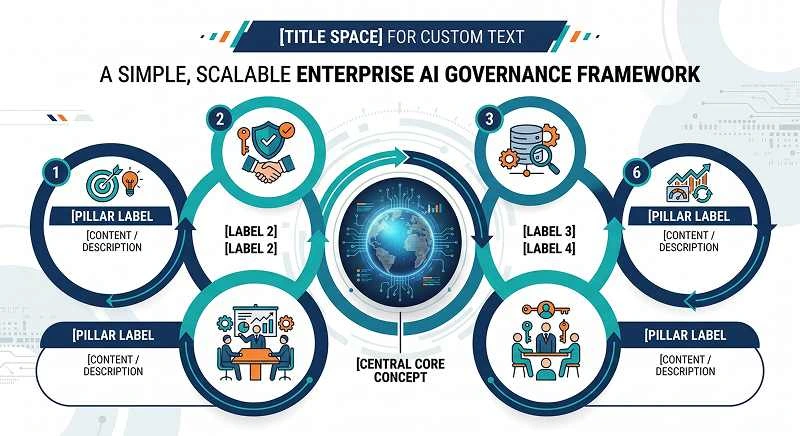
Start with a simple, scalable AI governance framework
Building strong AI governance does not require a massive program on day one; it requires a clear, scalable framework that can mature over time. A practical starting point includes four pillars: strategy alignment, risk and policy, lifecycle management, and oversight and reporting. Each pillar should have named owners, defined processes, and measurable outputs.
For example, strategy alignment clarifies which business outcomes AI should support and which use cases are off‑limits. Risk and policy define principles on fairness, transparency, and acceptable error rates. Lifecycle management covers model development, validation, deployment, and monitoring, borrowing from established model risk management practices in regulated industries. Oversight and reporting ensure that the board and executive committee receive regular, standardized updates.
A common mistake is trying to write a perfect, exhaustive AI policy before any governance mechanisms exist. In practice, it is more effective to start with a lean framework, apply it to a few high‑impact use cases, and iterate. This builds organizational muscle and avoids the trap of policy documents that look impressive but never influence day‑to‑day decisions.
Address common governance gaps that quietly derail AI efforts
In real organizations, a handful of recurring governance gaps explain why many AI transformations stall. These include unclear ownership, missing inventories, inconsistent approval criteria, and weak monitoring. Recognizing these early allows boards and executives to intervene before risk accumulates.
Common governance gaps that derail AI success include:
- No clear executive owner for AI strategy and risk.
- No centralized inventory of AI models, tools, and high‑risk use cases.
- Inconsistent standards for documentation, validation, and human oversight.
- Limited involvement from legal, compliance, and HR until late in the project.
- No defined thresholds for when to escalate AI incidents to senior leadership or the board.
Addressing these gaps typically requires modest structural changes but significant cultural shifts. Teams must accept that AI work is not “just another analytics project” and that governance is part of building, not an afterthought. Over time, organizations that internalize this mindset see AI become more predictable, auditable, and strategically aligned.
Learn more about: Major Trends in Technology Togtechify
What does the future of AI in the boardroom look like?
AI will become a standing lens on strategy, risk, and culture
Looking ahead, AI will not be a one‑off transformation program; it will be a persistent lens through which boards view strategy, risk, and organizational culture. The boards that succeed will be those that accepted early that ai transformation is a problem of governance and built the structures to handle it. They will treat AI alongside cybersecurity, ESG, and financial resilience as a core dimension of enterprise oversight.
In this future, board packs will routinely include AI risk dashboards, summaries of major AI incidents and responses, and updates on regulatory developments. Strategy discussions will examine not just “where can AI add value?” but also “how does AI change our responsibilities to customers, employees, and regulators?” Culture and talent reviews will consider how AI reshapes roles, incentives, and required skills.
It is worth noting that regulation is moving in the same direction. Emerging AI laws and guidelines increasingly emphasize governance: documented risk assessments, human oversight, transparency, and accountability chains. Organizations that build robust internal governance now will find it far easier to comply later, while also unlocking more sustainable value from AI.
Turning governance into a competitive advantage
When done well, AI governance is not a brake on innovation; it is a way to innovate with confidence. Companies that can demonstrate controlled, explainable, and ethically grounded AI will win trust from customers, regulators, and partners. They will be better positioned to scale high‑impact use cases because their boards and executives have visibility and confidence in the controls.
The key is to stop framing AI setbacks as purely technical failures and to recognize the governance gap at their core. Boards and leadership teams that act on this insight—by clarifying ownership, formalizing oversight, and embedding AI into existing governance structures—will turn a perceived constraint into a strategic asset. In the end, the organizations that thrive in the AI era will be those that understand that technology is only half the story; the other half is how they govern it.