

AI transformation is the shift from using AI as scattered experiments to embedding it into how a company creates value, makes decisions, and defines roles—and the core mistake is treating it as a technology rollout instead of an identity and work redesign challenge. In other words, AI transformation is an organizational and human problem long before it is a technical one, which is why so many “AI-first” programs stall after impressive pilots.
Learn more about: AI Transformation is a Problem of Governance
TL;DR – Key Takeaways
- AI transformation fails when leaders treat it as an IT upgrade instead of a reinvention of roles, identity, and value creation.
- The old digital-transformation playbook (tools, training, quick wins) is not enough for AI’s general-purpose, cross-functional impact.
- People freeze not because AI is hard to use, but because they can’t see who they will be in an AI-shaped future.
- Leaders need a structured framework: shared understanding, fear management, role redesign, governed experimentation, and identity-level integration.
- The companies that succeed treat “ai transformation not technology problem” as a guiding principle for strategy, culture, and governance.
Why Do “Textbook” AI Transformations Stall So Quickly?
What happens when leaders reuse the old digital playbook?
In practice, most executives start AI programs the way they ran past digital initiatives: create urgency, fund a few flagship projects, run training, and celebrate quick wins. On paper, it looks flawless—there is a roadmap, a vendor ecosystem, and an AI center of excellence. Yet six to twelve months later, dashboards show usage dropping, and most employees quietly revert to PowerPoint, spreadsheets, and manual workflows. Leaders did all the “right” things, but the organization is not fundamentally working any differently.
Based on experience working with large enterprises, the pattern is consistent: AI sits at the edge of the business, not in the core of how value is created. Teams treat AI tools as optional add-ons, not as the default way of thinking and operating. This is where many finally realize that ai transformation not technology problem is not a slogan; it describes why their carefully planned rollouts are failing to stick.
How is AI different from previous waves of technology change?
AI is a general-purpose capability that can touch nearly every function—sales, operations, HR, finance, product, and more—at the same time. There is no single “best practice” roadmap, because the right use cases depend on context, creativity, and how each role chooses to reinvent its own work. Unlike an ERP or CRM rollout, you cannot just standardize processes and push adoption from the top down.
According to industry experts, this makes AI transformation closer to changing the operating system of the company than installing a new app. It forces questions like, “What decisions can we delegate to machines?” and “What remains uniquely human in this role?” When those questions are not addressed explicitly, people sense the threat but get no guidance, and they understandably hesitate to lean in.
What Makes AI Transformation a Human and Identity Challenge?
Why does AI feel like an attack on “who I am” at work?
AI does not only change how we work; it challenges who we believe ourselves to be as professionals. For a seasoned analyst, copywriter, claims adjuster, or sales manager, much of their pride comes from expertise built over years of practice. When a model can draft a report, summarize a contract, or generate a sales email in seconds, it can feel like a direct hit to that identity. People ask, often silently, “If the machine can do this, what is left of my value?”
Research shows that when identity is threatened and the future feels ambiguous, people tend to freeze, avoid, or sabotage change—even if they intellectually understand the benefits. This is why ai transformation not technology problem must be treated as a psychological and cultural challenge: until individuals can see a credible, positive version of themselves in an AI-enabled future, they will not fully adopt the tools.
How does this identity shock show up inside organizations?
On the surface, you see polite compliance: employees attend AI training, complete e-learning modules, and nod in town halls. Underneath, you see quiet resistance: people double-check everything the model suggests, avoid using it in front of clients, or claim they are “too busy” to experiment. Managers often reinforce this by rewarding output produced the old way and penalizing visible “learning time.”
A common real-world example is Company A, a global financial-services firm. They rolled out a powerful generative AI assistant for relationship managers but never addressed the fear that “AI will make my client skills less valuable.” Adoption plateaued under 15% until leadership reframed the narrative: AI would handle prep work so managers could spend more time in high-trust conversations. Once identity was re-anchored, usage and performance both climbed.
How Should Leaders Rethink AI: A Framework for Reinvention
What are the core questions leaders must help people answer?
At its core, AI transformation is about identity and value creation, not technology. It asks:
- What part of your thinking, processing, or routine work are you willing to give to the system?
- What does that free you up to do that you could not do before?
- What do you want your work—and your team’s work—to become in this new environment?
These questions must be answered at every level: executive, manager, and individual contributor. When leaders skip this reflection, they inadvertently send the message that AI is just about efficiency and cost-cutting. When they lean into it, they signal that the goal is to elevate human contribution, not erase it, reinforcing the idea that ai transformation not technology problem but a redesign of roles and aspirations.
How does a reinvention framework make AI real, not abstract?
Based on experience across industries, successful companies use a structured framework that balances learning, emotion, and organization design. They do not rely on inspirational keynotes or isolated pilots alone. Instead, they combine large-scale education, explicit fear management, intentional role redesign, governed experimentation, and integration into identity and governance.
To make this concrete, consider three anonymized examples: Company A (financial services, North America), Company B (manufacturing, Europe), and Company C (retail, Asia-Pacific). Each started from different levels of AI maturity, but all realized that without a human-centered framework, their technical investments would stall. The following five steps synthesize what works in practice.
Learn more about: AI Driven ERP Systems Future of Nusaker
What Are the 5 Essential Steps to Lead AI Transformation Effectively?
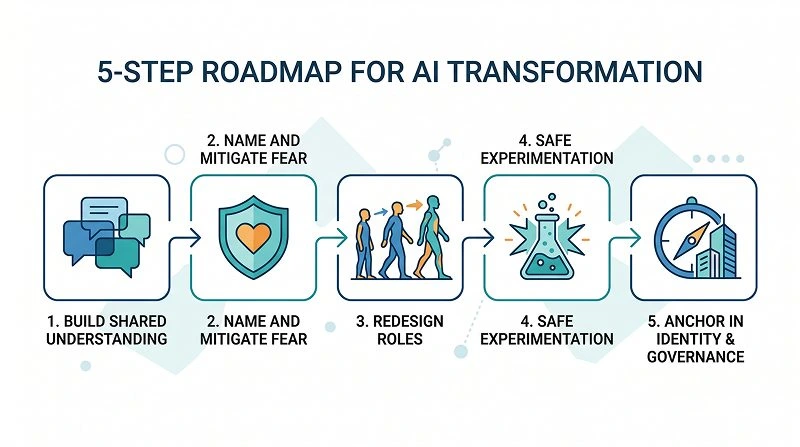
1. Build Shared Understanding, Not Just Skills
The first step is to create a realistic, shared understanding of what AI is, what it can and cannot do, and how it might change work. This goes beyond “how to use the tool” and into scenarios, limitations, risks, and examples tailored to each function. When people have a common language, they can have better conversations about opportunities and boundaries instead of reacting to hype or fear.
Company A ran full-day AI immersion sessions for senior leaders, followed by role-specific workshops for managers and staff. They used live demos of their own data and processes, not generic examples, which made the possibilities and constraints tangible. According to feedback surveys, this cut through both unrealistic optimism and paralyzing anxiety, creating a more grounded starting point for change.
2. Name and Mitigate the Fear of Change
The second step is to deal directly with fear, instead of pretending it does not exist. Leaders must be explicit about the purpose of AI: Is it primarily about layoffs and short-term cost cuts, or about growth, innovation, and resilience? Ambiguous messaging is interpreted as threat, which pushes people into defensive behavior and slows transformation.
Company B, a large industrial manufacturer, created an “AI Strategy Council” that included HR, operations, legal, and frontline representatives. The council’s mandate was not only to prioritize use cases but also to define guardrails on workforce impact and communicate them transparently. By stating clearly that AI gains would be reinvested into new products and markets, not automatic headcount reductions, they reduced resistance and increased participation in pilots.
3. Redesign Roles to Raise the Bar of Human Contribution
The third step is to explicitly redesign roles around what humans do best when machines handle more of the routine. AI can draft, summarize, classify, and predict at scale; humans excel at judgment, ethics, relationships, creativity, and cross-context problem solving. If job descriptions, KPIs, and career paths do not change, employees will keep optimizing for the old definition of “good work.”
In Company C, a regional retailer, merchandisers initially viewed AI demand-forecasting tools as a threat to their expertise. Leadership responded by redefining the role: instead of spending most of their time on spreadsheet analysis, merchandisers would focus on assortment strategy, vendor relationships, and experimentation with new formats. Performance reviews were updated to emphasize these higher-order skills, and AI became a partner rather than a rival.
4. Create Safe, Governed Spaces for Experimentation
The fourth step is to institutionalize experimentation so employees can learn by doing without fear of punishment. This means setting clear guidelines on what is allowed, what is off-limits, and how to escalate issues, while also protecting time and resources for pilots. Without this, AI use either becomes a compliance risk or remains stuck in unofficial “shadow experiments.”
Company B introduced “AI sandboxes” for each business unit, with small budgets and simple approval processes. Teams could propose experiments, run them on limited scopes, and share results in monthly forums. Governance teams monitored for security, privacy, and bias issues, but the overall tone was supportive. This structure balanced innovation with risk management and signaled that thoughtful experimentation was part of the job.
5. Anchor AI in Organizational Identity and Governance
The fifth step is to weave AI into how the organization sees itself and how it makes decisions at the top. This means integrating AI into strategy cycles, board discussions, risk frameworks, and leadership development—not treating it as a side project. When AI is part of the company’s identity, people understand that this is not a temporary initiative but a new way of operating.
Company A updated its corporate narrative from “a trusted financial institution” to “a trusted, AI-augmented financial partner,” and backed it up with concrete commitments in customer experience and employee development. The board added AI capability to its skills matrix and requested regular updates on impact, risks, and workforce implications. Over time, this made it clear that ai transformation not technology problem but a core element of how the business competes and serves its stakeholders.
How Can Leaders Turn AI Anxiety into a Catalyst for Growth?
What is the leader’s real job in AI transformation?
The real job of leaders in AI transformation is not selecting the perfect toolset; it is creating the psychological and organizational conditions for people to reinvent their work. This involves telling a credible story about the future, providing learning and experimentation opportunities, and aligning incentives with the new definition of value. Tools matter, but they are the last step, not the first.
According to experts in organizational change, employees are more likely to embrace AI when they feel three things: safety (my job and dignity are not under constant threat), agency (I have a voice in how my role evolves), and meaning (my work still matters and may even matter more). Leaders who ignore these dimensions will see slow, fragile adoption; those who address them head-on can turn AI into a catalyst for growth and renewed engagement.
What can executives start doing this quarter?
Executives can start by asking every function to answer three questions:
- Where can AI take over repetitive, low-judgment tasks in your area today?
- If that work disappeared from human to-do lists, what higher-value activities could your people focus on?
- What skills, structures, and safeguards would you need to make that shift real?
From there, they can launch targeted learning programs, set up cross-functional AI councils, and redesign a handful of roles as visible prototypes. The message should be consistent: this is a long-term reinvention of how we create value, not a short-term technology project. When organizations internalize that ai transformation not technology problem but a human and identity challenge, they finally stop chasing tools and start reshaping the future of work in a way their people can believe in and build with them.