

Small business web design and management services combine strategic planning, visual design, and ongoing maintenance to keep your website generating leads instead of headaches. When these pieces are handled well, your site loads fast, ranks in search, builds trust, and quietly turns visitors into customers while you focus on running the business.
TL;DR (Quick Summary)
- Your website is a core business asset, not a one-time project, and it needs both design and ongoing management.
- Most small businesses struggle because they try to DIY without a strategy, process, or enough time.
- User-centered, data-driven design typically improves conversions, lowers bounce rates, and increases organic traffic.
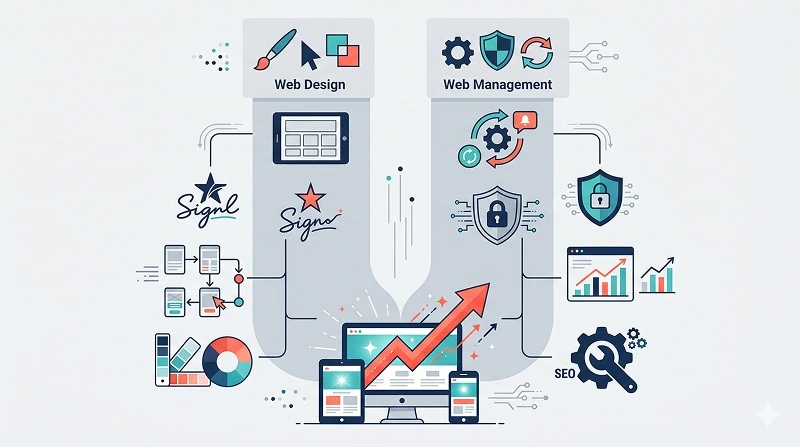
- Design focuses on look, structure, and experience; management focuses on updates, security, and performance.
- The easiest way to get this off your plate is to partner with a team that treats your site like a living, evolving sales channel.
What Is Small Business Web Design and Management, Really?
How Do Design and Management Work Together for a Small Business Website?
Small business web design and management is the combination of creating your website’s look and feel, then continuously maintaining and improving it so it keeps driving business results. In practice, design covers layout, branding, user experience, and content structure, while management covers updates, security, performance, and ongoing optimization.
From experience, we see small businesses run into trouble when they treat the website as a one-time “launch” instead of a long-term asset. According to industry research, websites that are actively maintained and optimized can generate up to 2–3x more leads than static, “set it and forget it” sites. That difference usually comes down to whether someone is actually accountable for managing the site after launch.
At our agency, we follow a user-centered, data-driven approach from day one. As our founder often says, “If it doesn’t solve a real user problem and move a business metric, it doesn’t belong on the page.” We start by mapping user journeys, define clear conversion goals, then design and manage the site around those goals.
Why Does This Feel So Overwhelming for Small Business Owners?
This feels overwhelming because you’re being asked to be a marketer, designer, developer, copywriter, and IT manager on top of running your company. In real-world projects, we regularly meet owners juggling plugins, page builders, hosting issues, and Google updates late at night, which is simply not sustainable.
There are also too many disconnected tools: website builders, analytics, email platforms, SEO tools, security plugins, and more. Without a clear strategy and process, every decision feels like a guess, and every update feels risky. That’s the point where many owners either stop updating the site altogether or make changes that accidentally hurt performance or rankings.
When you view your website as a system rather than a collection of pages, the picture changes. The goal is no longer “finish my website,” but “set up a reliable process so my website keeps working for the business.” That’s exactly what professional small business web design and management services are built to provide.
What Real Results Can Professional Web Design and Management Deliver?
How Do Professional Services Translate Into Measurable Business Outcomes?
Professional design and ongoing management translate into measurable outcomes like more leads, higher conversion rates, and better customer retention. In our own client work, we routinely see conversion rates increase by 30–70% after redesigns that simplify navigation, clarify messaging, and improve page load times.
For example, a local service business we worked with saw form submissions increase by 52% within three months of launching a redesigned site focused on clear calls to action and mobile usability. At the same time, their bounce rate dropped by 18%, which told us users were finding what they needed instead of leaving frustrated. These improvements came from structured A/B testing, heatmap analysis, and user feedback—not guesswork.
Research shows that even a one-second delay in page load time can reduce conversions by up to 7%. That’s why we treat performance optimization and technical maintenance as core parts of management, not optional add-ons. The outcome is a site that not only looks professional but also performs like a true sales and marketing engine.
Why Is a User-Centered, Data-Driven Approach So Critical?
A user-centered, data-driven approach is critical because it removes guesswork and aligns your website with how real people actually browse, decide, and buy. Instead of designing around internal opinions (“we like this color” or “put everything on the homepage”), we design around user behavior and business goals.
In practice, that means using tools like analytics, session recordings, and user surveys to answer specific questions: Where do users drop off? Which pages drive the most leads? What questions keep coming up in support tickets? We then adjust layouts, content, and calls to action based on those findings.
Over time, this approach compounds. One small improvement—like simplifying a form or rewriting a confusing headline—can increase conversions by 10–20%. When you repeat that process month after month, your site becomes sharper, clearer, and more profitable without needing a complete rebuild every year.
If you’re already thinking about improving your site, this is a good moment to pause and document your goals—traffic, leads, calls, or sales—so any partner you work with can design and manage around those outcomes.
What Are the Core Benefits of Professional Web Design and Management?
How Does a Well-Designed Site Improve User Experience (UX)?
A well-designed site improves user experience by making it easy for visitors to understand who you are, what you offer, and what to do next—without friction or confusion. In our experience, the fastest UX wins for small businesses come from clear navigation, scannable content, and obvious calls to action.
User-centered design starts with understanding your primary audiences and their top tasks. For example, a home services company might prioritize “get a quote” and “see reviews,” while a professional firm might prioritize “view services” and “book a consultation.” We organize pages, menus, and content around those tasks so users can succeed quickly.
According to usability studies, users often decide within 5–8 seconds whether to stay or leave a site. That means your above-the-fold section needs to answer three questions immediately: “Where am I?”, “What can I do here?”, and “Why should I trust this business?” Good UX design makes those answers obvious.
How Does Strong Design and Management Improve SEO and Visibility?
Strong design and ongoing management improve SEO by ensuring your site is technically sound, well-structured, and consistently updated with relevant content. Search engines reward fast, mobile-friendly, secure sites with clear information architecture and helpful content that matches user intent.
From a technical standpoint, we focus on clean code, optimized images, proper heading structure, and logical internal linking. These elements help search engines crawl and understand your site more easily, which can improve rankings over time. Regular management also ensures plugins, themes, and integrations stay updated so technical issues don’t quietly hurt your SEO.
On the content side, we build pages around topics and questions your ideal customers actually search for. According to multiple industry reports, businesses that publish and maintain high-quality, optimized content can see organic traffic grow by 50–100% within a year. The key is consistency and alignment with real search behavior, not chasing every new SEO trick.
How Does a Professional Online Presence Boost Credibility and Trust?
A professional online presence boosts credibility by signaling that your business is legitimate, stable, and detail-oriented. When users see a modern design, consistent branding, clear messaging, and up-to-date information, they’re more comfortable taking the next step—whether that’s submitting a form, calling, or making a purchase.
A common real-world example is the “trust gap” between two local competitors: one has a polished, mobile-friendly site with reviews, case studies, and clear contact info; the other has an outdated, broken, or generic site. Even if both deliver similar services, users overwhelmingly contact the business with the stronger digital presence.
Worth noting, credibility is not just about visuals; it’s also about accuracy and reliability. Good management ensures your hours, pricing, team information, and service details stay current. Nothing erodes trust faster than outdated promotions, broken forms, or incorrect contact information.
How Do Design and Management Differ—and Why Do You Need Both?
What Exactly Is “Web Design” in a Small Business Context?
In a small business context, web design is the process of planning and creating the visual layout, structure, and user experience of your website. It includes branding, color palettes, typography, imagery, page layouts, and how users move from one section to another to accomplish their goals.
We typically break design into three phases: discovery, wireframing, and visual design. Discovery clarifies your audience, goals, and competitive landscape; wireframing maps content and functionality; visual design applies your brand and refines the interface. Each phase builds on the previous one to avoid random or purely aesthetic decisions.
Good design also accounts for responsiveness—how your site behaves on different screen sizes and devices. With mobile traffic often representing 50–70% of visits, designing “mobile last” or as an afterthought is a costly mistake that can directly reduce leads and sales.
What Is “Web Management” and Why Is It Not Optional?
Web management is the ongoing work of keeping your website secure, updated, fast, accurate, and aligned with your current business goals. It includes software updates, backups, uptime monitoring, performance tuning, content updates, SEO refinements, and analytics review.
According to security reports, a large percentage of hacked small business sites were running outdated software or plugins. Regular updates and monitoring dramatically reduce that risk, while backups ensure you can recover quickly if something goes wrong. This is where many DIY setups fail—not at launch, but 6–18 months later when no one is actively watching the site.
From a business perspective, management is also where continuous improvement happens. Each month, you can review key metrics—traffic, conversions, bounce rates, top pages—and make targeted changes. Over time, this turns your website into a living asset that adapts to your market instead of falling behind it.
Why Is Treating Design and Management as a Package More Effective?
Treating design and management as a package is more effective because it ensures continuity between strategy, execution, and ongoing optimization. The team that designed the user journeys and conversion paths is best positioned to interpret the data and refine those elements over time.
When design and management are split between different providers—or when management is left to “whoever has time”—important context gets lost. Decisions become reactive instead of strategic, and improvements stall. In contrast, an integrated team can say, “We launched this layout to increase quote requests; here’s how it’s performing and what we’ll test next.”
For small businesses, this integrated approach also simplifies communication and accountability. You have a single partner responsible for both the way the site looks and the way it performs, which makes it easier to get issues resolved and opportunities implemented quickly.
How Do You Finally Get Web Design and Management Off Your Plate?
What Should You Look for in a Web Design and Management Partner?
You should look for a partner that understands small business constraints, offers clear packages, and can speak to both design quality and ongoing management. Ask about their process from discovery through launch and beyond, and request examples of before-and-after results with real metrics.
From experience, the most reliable partners are transparent about what’s included: hosting or not, response times, security practices, content updates, and reporting. They should be comfortable explaining technical topics in plain language and connecting every recommendation back to a business outcome, not just a technical preference.
It’s also worth asking how they handle strategy. Do they help you define goals and KPIs? Do they set up analytics and dashboards? A strong partner will proactively schedule reviews and bring you ideas based on data, rather than waiting for you to notice problems.
How Can You Stay in Control Without Doing All the Work?
You can stay in control by setting clear goals, approving strategy, and reviewing results regularly, while delegating execution and day-to-day tasks to your partner. Think of it like having a fractional web and marketing team: you set direction, they handle the details.
Practically, this often looks like a monthly or quarterly check-in where you review key metrics, discuss what’s working, and agree on next priorities. Between those check-ins, your partner handles updates, tests improvements, and monitors performance and security. You get visibility and decision-making power without having to log into your site every week.
This is where small business web design and management services provide the most value: they turn a constant source of stress into a managed, measurable function of your business. You gain time back, reduce risk, and get a website that keeps improving instead of slowly decaying.
Conclusion: How Do You Turn Your Website into a Real Business Asset?
What Are the Key Takeaways—and What Should You Do Next?
The key takeaway is that your website is not just a digital brochure; it’s a core business asset that needs both thoughtful design and consistent management to perform. When handled properly, it can improve user experience, increase visibility, build trust, and generate a steady flow of leads and customers.
If you’ve been trying to juggle everything yourself, it’s understandable that web design, updates, security, and SEO feel overwhelming. According to experts and real-world results, the most effective path is to define clear goals, then partner with a team that uses a user-centered, data-driven approach to handle the heavy lifting. That’s exactly what modern small business web design and management services are built to deliver.
The next practical step is simple: document your top three website goals, gather any existing analytics or feedback, and start a conversation with a qualified provider. With the right partner, you can finally get your website off your plate—and turn it into a reliable, measurable driver of growth for your business.