
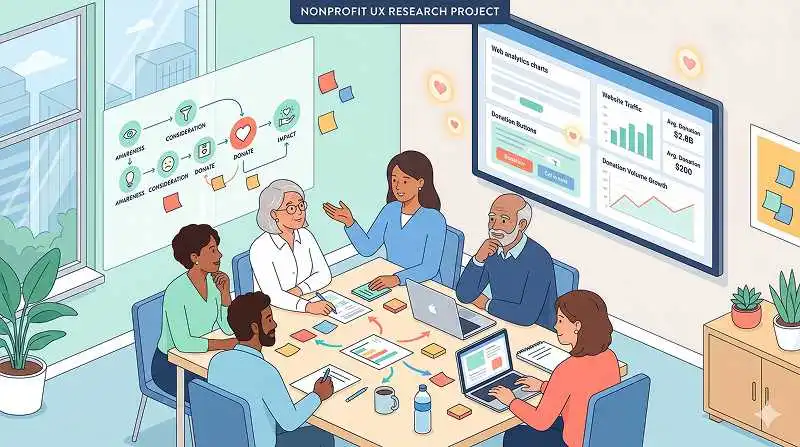
A UX Research Project for Nonprofit Organization work is a focused effort to understand how real donors, volunteers, and community members experience your digital touchpoints so you can remove friction and increase impact. In practice, this means systematically learning where people struggle or drop off in key journeys like donating, signing up to volunteer, or accessing services, then using that evidence to guide design and content decisions.
Learn more about: Why UX Design Strategy is Important
TL;DR – How to Get High‑Impact Donor Insights on a Nonprofit Budget
- Start with the nonprofit context: mission, constraints, diverse users, and the need for trust.
- Narrow your research scope to 1–2 critical journeys, like donations or volunteer sign‑up.
- Reuse existing data (analytics, CRM, support emails) before planning new studies.
- Involve internal and external stakeholders early so they own the findings and act on them.
- Turn insights into small, testable changes and measure outcomes with simple, clear metrics.
Why Is UX Research Different for Nonprofit Organizations?
Nonprofit UX research must balance mission impact, trust, and limited resources in ways that differ from commercial projects.
Nonprofit organizations operate in a different environment from traditional businesses. Their main goal is social impact, not revenue. That shift changes how research priorities should be approached. Instead of optimizing for sales, nonprofits often focus on actions like recurring donations, event participation, or program enrollment. Teams also need to work within sensitive contexts and limited budgets. When organizations ignore these realities, they often copy commercial UX patterns that confuse or alienate their audiences.
Several characteristics shape how you should design and run studies:
- Mission at the center: Every research question should tie back to advancing the mission or strategic goals.
- Chronic resource constraints: Small teams and tight budgets demand lean, high‑leverage methods.
- Multiple, very different user groups: Beneficiaries, donors, volunteers, staff, and partners all have distinct goals.
- Heightened sensitivity around trust: People must feel safe sharing data, stories, and money with you.
A common real-world example is a donation page that tries to do too much at once. Many pages attempt to tell the organization’s story, display impact statistics, collect newsletter sign-ups, and process payments in a single flow. This can overwhelm donors and create uncertainty about where their money is going. As a result, users often abandon the process right before payment. By mapping the donation journey and observing a few usability sessions, teams can quickly identify moments of confusion and hesitation.
Research methods such as journey mapping, user interviews, and lightweight usability testing work especially well for nonprofits. These methods reveal both emotional and practical friction points. Journey mapping helps teams understand the full donor experience, from first awareness to post-donation follow-up. Interviews uncover motivations, concerns, and trust issues. Usability testing shows exactly where people struggle or become stuck. Together, these insights help nonprofits create digital experiences that align with both user needs and organizational goals.
How Do You Define Research Goals When Your Budget Is Tight?
To define research goals on a tight budget, you must ruthlessly prioritize a small number of critical UX problems and link them to measurable outcomes.
Nonprofit teams often tell me they “don’t have time for research,” but what they really lack is a clear, narrow focus that fits their capacity. Industry data shows that even five to eight well‑selected usability sessions can uncover 80% of major issues in a given flow. The key is to stop trying to “research everything” and instead choose one high‑value journey where better UX would clearly move the needle.
Practical strategies that work well with limited resources include:
- Prioritize one journey: Focus on the donation flow, volunteer onboarding, or program application—not all three.
- Set 1–3 concrete metrics: For example, increase completed donations by 15% or cut drop‑off on the payment step by 30%.
- Mine existing data first: Use analytics, CRM reports, email feedback, and staff anecdotes to pinpoint where to dig deeper.
- Scope to answerable questions: Ask “Why are donors abandoning at step 3?” rather than “How can we improve our whole website?”
In practice, a strong UX Research Project for Nonprofit Organization often starts with a two‑hour workshop where digital staff, fundraising, and program leads list their biggest frustrations and align on a single priority. This sharp focus makes it much easier to choose methods, recruit participants, and later explain findings in a way that drives action. For teams needing more structure, resources like a “Nonprofit UX Prioritization Canvas” or a partner‑selection checklist can help decide whether to keep work in‑house or bring in external specialists for the most critical pieces.
What Are the Key Steps in a Lean Nonprofit UX Research Project?
A lean nonprofit UX research project follows a simple sequence: clarify goals, audit existing data, run small focused studies, then translate findings into design decisions.
According to experts in human‑centered design, the biggest ROI comes from combining multiple lightweight methods rather than betting everything on one large, expensive study. In nonprofit settings, I typically recommend a four‑step approach that can be executed in 4–8 weeks, depending on team capacity. This cadence respects real‑world constraints while still producing robust, actionable insight.
A practical, budget‑friendly sequence often looks like this:
- Step 1 – Discovery & alignment: Hold a short workshop to define the user journey, success metrics, and research questions.
- Step 2 – Data review: Analyze web analytics, form completion rates, and support tickets to identify clear problem spots.
- Step 3 – Primary research: Run 5–10 user interviews and 5–8 usability tests on the critical flow.
- Step 4 – Synthesis & prioritization: Cluster findings, estimate impact vs. effort, and create a short, visual findings deck.
A common real‑world example is a mid‑size nonprofit that wants to boost monthly donors. They start by reviewing analytics and see that many people click “Donate” but abandon on the second step of the form. Short interviews reveal that donors feel uncertain about how recurring gifts are used, and usability tests show that the “Make this monthly” option is buried and confusing. The final recommendations—clearer copy, a simplified form, and more transparent impact messaging—are inexpensive to implement but often produce measurable gains within a campaign cycle.
Learn more about: How Do You Start Building Your Information Architecture
How Should You Involve Stakeholders and Donors in the Research?
Involving stakeholders and donors early and transparently makes research smoother, builds internal buy‑in, and improves the relevance of your findings.
In nonprofit environments, success is rarely about having the “best” insight; it is about whether fundraising, programs, communications, and leadership feel comfortable acting on it. Based on experience, projects that ignore internal politics or frontline perspectives usually stall after the final presentation. Conversely, when stakeholders help shape questions and observe sessions, they are far more likely to champion the resulting changes.
Effective stakeholder and participant engagement practices include:
- Bring stakeholders in at the start: Invite fundraising, communications, and program leads to the scoping workshop.
- Communicate purpose and ethics clearly: Explain how participant data will be used, stored, and anonymized.
- Offer observation opportunities: Let staff watch usability sessions (live or recorded) so they see issues firsthand.
- Include diverse voices: Recruit donors of different giving levels, ages, and backgrounds, plus volunteers and beneficiaries where relevant.
Worth noting, you should treat donors and community members as partners in improving the experience, not as test subjects. A simple practice is to end each session by asking, “Is there anything we did not ask that you think we should know?”—this often surfaces unexpected insights and makes participants feel respected. For organizations looking to formalize this, advanced guides on ethical research with vulnerable populations can provide frameworks for consent, compensation, and data protection aligned with nonprofit values.
How Do You Turn UX Findings Into Mission‑Aligned Action?
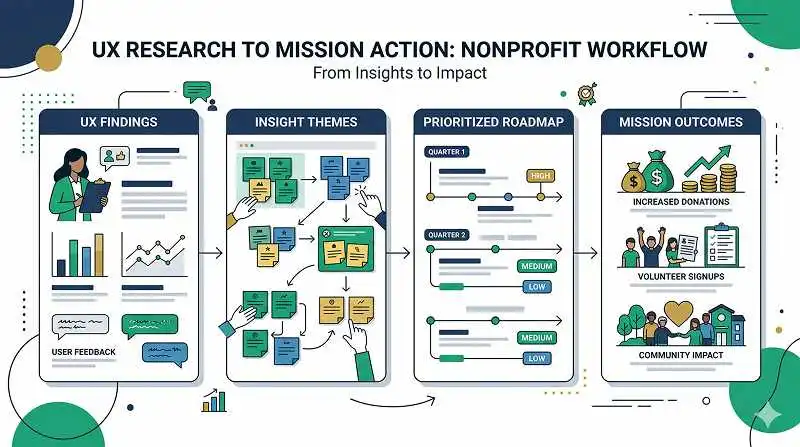
To turn UX findings into action, you must translate insights into a prioritized, realistic roadmap that clearly connects design changes to mission outcomes.
Research shows that many UX projects fail not in the discovery phase, but in the “last mile” where teams struggle to implement recommendations. In nonprofits, this problem is amplified by limited development capacity and competing campaign timelines. The solution is to package findings in a way that directly speaks to leadership and fundraisers: what to change, why it matters, how hard it is, and what impact you expect.
A practical way to do this is:
- Cluster insights by journey step: For example, “Pre‑donation,” “Form completion,” “Post‑donation stewardship.”
- Score each recommendation: Use a simple impact vs. effort matrix to decide what to tackle now, next, and later.
- Link to metrics and mission: Show how a simpler form could mean X more completed donations and Y more people served.
- Plan small experiments: Run A/B tests or phased rollouts instead of a single, high‑risk redesign.
A common example: after a focused UX Research Project for Nonprofit Organization on the donation journey, a team identifies three quick wins—shortening the form, adding a short impact statement near the donate button, and improving mobile responsiveness. They implement these first, then track conversion rates and average gift size for 4–6 weeks. When the numbers move in the right direction, those results become a powerful story to secure internal support and possibly external funding for deeper UX investments.
How Can Nonprofits Sustain UX Research Without Overspending?
Nonprofits can sustain UX research by integrating small, repeatable research habits into existing workflows instead of treating it as a one‑time, expensive project.
Rather than waiting for a large grant to fund a full redesign, high‑performing organizations build “continuous discovery” into their regular operations. This might look like running quarterly usability tests on priority flows, adding one or two user interviews to major campaign planning, or reviewing analytics monthly with a UX lens. Over time, these habits reduce risk and help teams make evidence‑based decisions without needing a huge, separate budget line.
Sustainable practices often include:
- Create lightweight templates: Standardize scripts, consent forms, and note‑taking to lower the barrier to running studies.
- Train internal champions: Upskill a few staff members in basic UX research methods and analysis.
- Leverage free or low‑cost tools: Use tools like Google Analytics, low‑cost testing platforms, or remote interview tools.
- Document and share learnings: Maintain a simple “insight library” so future projects can reuse past findings.
In practice, the most resilient nonprofits treat each UX research project as part of a long-term learning process, not a one-time task. Teams regularly revisit past insights when launching new programs. They also compare donor feedback with service user feedback to identify patterns and gaps. This ongoing approach helps organizations make decisions that stay data-informed, user-centered, and aligned with their mission, even when budgets or staffing levels change.
Nonprofits that understand their unique context often get more value from every research effort. Clear research goals and consistent stakeholder involvement make studies far more effective. A successful UX research project does not require a massive budget. It requires focus, ethical engagement, and a commitment to turning insights into measurable improvements. When organizations apply these practices consistently, they create experiences that are easier to use, more trustworthy, and more inclusive for the people they serve.
Learn more about: How to Become a UX Researcher