
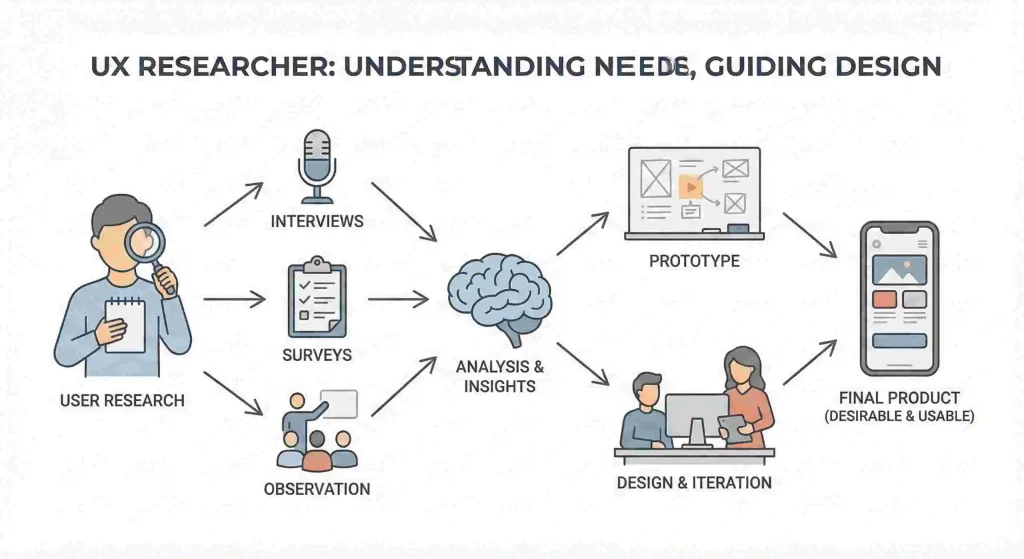
In the last few years, demand for UX research has surged as more teams realize that “building fast” is not the same as “building right.” When product decisions are made on assumptions, the cost of being wrong compounds quickly through rework, churn, support tickets, and missed growth opportunities.
That is why spending money on user research is no longer something only big companies do. More startups and mid-sized teams now treat UX research as a core function because they cannot afford to skip it. The cost of wrong assumptions is often higher than the cost of research.
Learn more about: why User Experience Design is Important
So, what does a UX researcher do in practice, and how do they help product teams design better experiences? Let’s clear things up.
So, what does a UX Researcher do?
Put simply, a UX researcher’s job is to understand users what they need, how they behave, and why—and translate that understanding into actionable guidance for product and design decisions.
Poetically speaking, a UX researcher saves your product from a tough clash with reality.
Where UX research fits in product design
UX research is tightly connected to product design because design is fundamentally a decision-making process. You choose what to build, what to prioritize, how to structure flows, what language to use, and what trade-offs are acceptable. Research reduces guesswork in those decisions.
Many teams describe this through the design thinking framework, where research is especially prominent early on—when you’re framing the problem and building empathy for users—but it also continues through prototyping, validation, and iteration.
Design thinking process — Source
To put it simply, UX research supports product design by making sure the team is solving the right problem for the right people, in the right way.
UX researcher roles and responsibilities
UX researcher roles diagram
The main UX research responsibilities are to listen to users, gather data from them, and translate it into valuable information for the design team and stakeholders. This involves planning and running studies, making sense of patterns, and communicating findings so teams can act on them.
A UX researcher is not there to “tell designers what to do.” Instead, they bring evidence: insights, user needs, and usability issues. The design team then uses this to create solutions, validate them, and refine.
The UX research process typically includes collecting data, processing and analyzing it, identifying weak points in the product, suggesting ways to fix them, and testing solutions with users to get real feedback.
Day-to-day UX research tasks include:
- Defining research goals tied to product decisions
- Setting scope (what you will and won’t answer)
- Building a research plan and timeline
- Choosing the right methods (qualitative, quantitative, or mixed)
- Recruiting participants that match target users
- Writing research scripts and discussion guides
- Conducting studies (interviews, usability testing, surveys, card sorting, etc.)
- Organizing raw notes, recordings, and metrics
- Synthesizing results into themes and clear findings
- Presenting reports and facilitating stakeholder alignment
UX researchers work closely with UI/UX designers to propose changes and new solutions based on real user evidence—and they often collaborate with product managers, engineers, marketing teams, customer success, and leadership to ensure research influences strategy.
Common responsibilities from real job descriptions often include:
- Designing and executing research to support business and product objectives
- Collaborating with design teams to define intent, develop prototypes, and refine solutions
- Building user journeys, personas, and segmentation models
- Running a variety of studies (usability tests, field studies, concept tests, diary studies, group discussions)
- Combining quantitative and qualitative data to guide decisions
- Communicating insights clearly to cross-functional stakeholders
- Advocating for user needs in prioritization and roadmap discussions
UX researcher skills
UX researcher skills diagram — Image credit
A UX researcher’s skillset is diverse, but it is not only about tools or technical depth. One of the most valuable abilities is seeing patterns in human behavior—and that comes from experience, not just training.
UX research roles are often “soft-skill heavy.” In practice, strong communication, empathy, and synthesis can matter more than advanced tooling.
Hard skills
- Knowledge of UX research methods, such as usability testing, heuristic evaluation, tree testing, and card sorting
- Ability to choose the right method for the question (exploration vs validation vs measurement)
- Familiarity with data processing workflows (from spreadsheets for small projects to specialized research repositories)
- Experience with research tools (for example: session recordings, heatmaps, prototype testing tools, and design platforms)
- Basic visual literacy to communicate effectively with designers and understand UI interactions
- Report writing and insight storytelling (translating messy inputs into clear actions)
Soft skills
UX researcher soft skills illustration — Image credits
- Communication skills: asking good questions, building rapport, summarizing accurately, and aligning stakeholders
- Empathy: noticing friction, hesitation, and emotional responses during tests—and understanding the “why” behind them
- Critical thinking: keeping the research unbiased, avoiding leading questions, and resisting confirmation bias
- Analytical thinking: synthesizing qualitative themes and interpreting quantitative signals
- Facilitation: running workshops, debriefs, and decision sessions so insights turn into action
- Stakeholder management: clarifying expectations, dealing with constraints, and maintaining trust in the research process
When do you need a UX researcher…
There are cases where a dedicated UX researcher is a strong investment—and cases where other roles can cover research sufficiently. In general, it is a good idea to cooperate with a UX research specialist when:
- You do not have a clear vision of your product and future user base, and you need to validate who you are building for
- You are stuck on product strategy and need evidence to prioritize problems and opportunities
- Your product serves a diverse audience with complex needs and edge cases that cannot be guessed from internal opinions
- You are about to redesign a key flow and want to avoid “pretty changes” that do not improve outcomes
- You are scaling and need consistent research operations: recruitment pipelines, templates, repositories, and continuous discovery
- Your team is making high-impact decisions (pricing, onboarding, core workflows) and needs confidence before shipping
…and when you don’t
Budget constraints or a small, simple product can be valid reasons to skip hiring a dedicated UX researcher—at least temporarily. In early-stage environments, it is common for a product designer or product manager to handle research tasks, especially if the scope is manageable and the team can keep discovery lightweight.
In many startups, one person plays both UI/UX designer and UX researcher. This can work if the designer has strong research fundamentals and the team is disciplined about not treating internal opinions as user truth.
That said, even if you do not hire a dedicated researcher, you still need research. The question becomes: will research be done consistently, and will it be done well enough to influence decisions?
A practical example: how research prevents expensive mistakes
Let’s say a team wants to redesign a dashboard because it looks outdated. A designer can produce a more modern UI quickly—but without research, the team may optimize aesthetics while missing the real problem.
A UX research approach might look like this:
- Review support tickets, user feedback, and churn notes to identify recurring complaints
- Conduct short interviews to understand user goals and context
- Run usability tests to see where users struggle, not where the team assumes they struggle
- Compare competitor products to understand industry patterns and user expectations
- Synthesize findings into key needs and prioritize them with product stakeholders
In many cases, the biggest insight is not “make it prettier.” It is something like: users cannot customize what matters to them, or cannot find key information fast enough, or do not understand what to do next.
That is the kind of insight that turns a redesign into a measurable improvement.
Conclusion
So, what does a UX researcher do? They make sure your product does not just make sense internally—but works for real people in the real world. They reduce guesswork, highlight weak points, uncover unmet needs, and help teams validate solutions before committing time and budget.
If you are feeling uncertain about your product direction, planning a redesign, or trying to align a team around what users actually need, UX research is often the most cost-effective place to start. Even a small research sprint can prevent months of rework and help you make decisions with confidence.
If you want UX research as part of product strategy or before a redesign—especially when the stakes are high—consider working with a UX-focused team that can both run the research and implement the insights. Drop us a line, and we can help you structure the right study, uncover actionable patterns, and translate findings into product design improvements.