
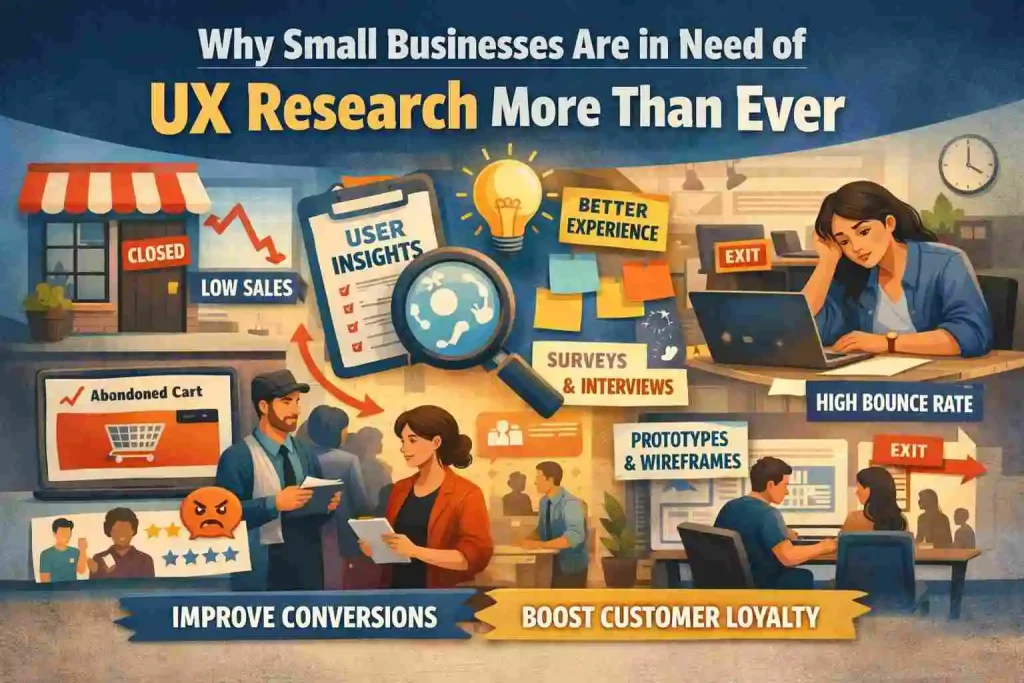
In an increasingly crowded digital marketplace, many small businesses still rely on intuition, internal opinions, or guesswork when making decisions. While this approach may have worked in the past, today it often leads to wasted resources, missed opportunities, and frustrated customers.
Running a business without truly understanding your users is like building a house without knowing who will live in it. The structure may stand, but comfort, efficiency, and long-term value are never guaranteed. This is exactly why small business in need of ux research has become a critical reality rather than a nice-to-have initiative.
UX research is no longer reserved for tech giants or global enterprises. In fact, small businesses arguably need it more than anyone else. When customer attention is scarce and competition is only one click away, experience becomes the ultimate differentiator.
Learn more about: Why UX Design Strategy is Important
This article explores why UX research is more important than ever for small businesses, how it directly impacts growth and profitability, and how it can be implemented realistically—even with limited budgets and resources.
What Is UX Research?
UX (User Experience) research is the systematic process of understanding user behaviors, needs, motivations, and pain points through observation, analysis, and direct feedback. It combines qualitative methods—such as interviews and usability testing—with quantitative data like surveys and analytics.
The purpose of UX research is not just to collect data, but to generate actionable insights that guide smarter decisions. It answers critical questions such as:
- Why do users abandon a website or app?
- Where do they feel confused or frustrated?
- What truly influences their decision to convert or leave?
For a small business in need of ux research, this clarity is invaluable. Instead of guessing what customers want, businesses can design experiences based on real user evidence—reducing risk and increasing impact.
Why Small Businesses Are in Need of UX Research More Than Ever
1. Competition Is Global, Not Local
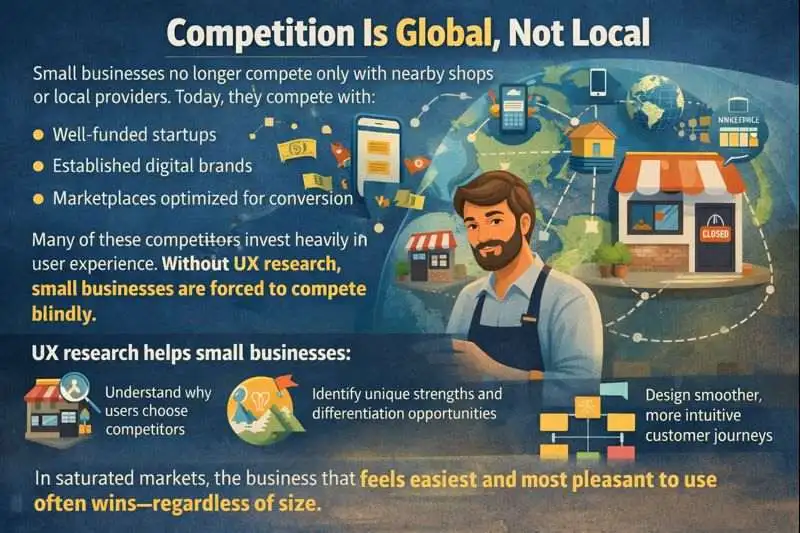
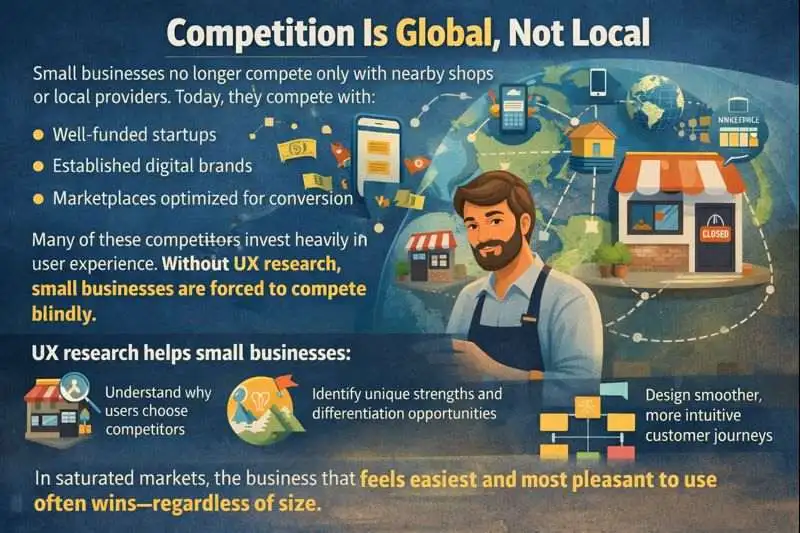
Small businesses no longer compete only with nearby shops or local providers. Today, they compete with:
- Well-funded startups
- Established digital brands
- Marketplaces optimized for conversion
Many of these competitors invest heavily in user experience. Without UX research, small businesses are forced to compete blindly.
UX research helps small businesses:
- Understand why users choose competitors
- Identify unique strengths and differentiation opportunities
- Design smoother, more intuitive customer journeys
In saturated markets, the business that feels easiest and most pleasant to use often wins—regardless of size.
2. User Expectations Are Higher Than Ever
Modern users expect seamless digital experiences by default. This includes:
- Fast-loading websites
- Clear navigation
- Mobile-friendly interfaces
- Simple checkout or booking processes
When expectations are not met, users rarely complain. They simply leave.
This reality makes small business in need of ux research more urgent than ever. UX research uncovers friction points before they silently damage conversions, reputation, and customer trust.
3. Limited Budgets Demand Smarter Decisions
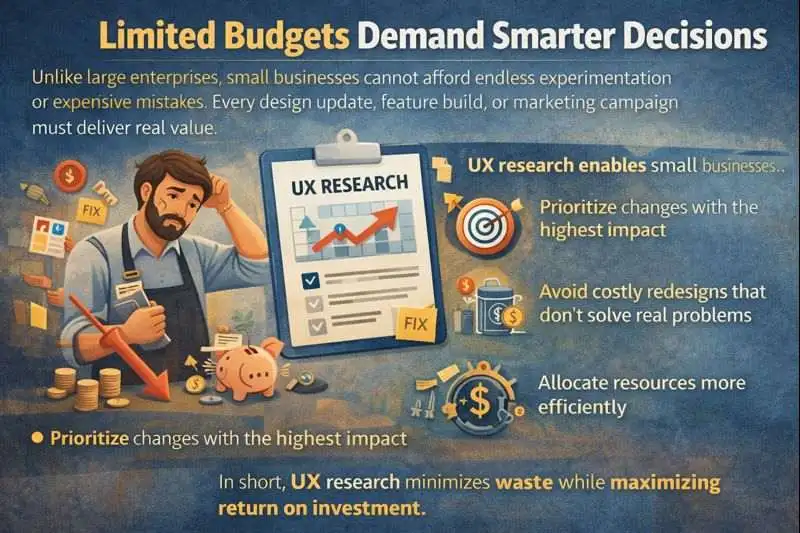
Unlike large enterprises, small businesses cannot afford endless experimentation or expensive mistakes. Every design update, feature build, or marketing campaign must deliver real value.
UX research enables small businesses to:
- Prioritize changes with the highest impact
- Avoid costly redesigns that don’t solve real problems
- Allocate resources more efficiently
In short, UX research minimizes waste while maximizing return on investment.
The Business Impact of UX Research for Small Businesses
Better Conversion Rates
UX research identifies exactly where users drop off or hesitate. Even small improvements—such as clearer calls to action or simplified forms—can significantly increase conversions.
For any small business in need of ux research, conversion optimization is often the fastest path to measurable growth.
Stronger Customer Loyalty
When users feel understood, they are more likely to return. UX research helps businesses design experiences that feel intuitive, respectful, and aligned with real needs.
This leads to:
- Higher retention
- Increased lifetime value
- Positive word-of-mouth referrals
More Confident Strategic Decisions
UX research replaces internal debates with evidence. Decisions are no longer based on opinions, but on user behavior and data.
This confidence is especially valuable for small teams where every decision has a direct impact on the business.
How Small Businesses Can Conduct UX Research on a Budget
Start with Customer Surveys
Surveys are one of the most accessible UX research methods. They allow businesses to gather insights quickly and affordably.
Effective surveys focus on:
- Ease of use
- Friction or confusion
- Barriers to conversion
For a small business in need of ux research, even a small number of high-quality responses can reveal powerful patterns.
Conduct User Interviews
User interviews provide depth that surveys cannot. They uncover motivations, emotions, and unmet needs that users may not explicitly state.
Best practices include:
- Asking open-ended questions
- Focusing on real experiences, not opinions
- Listening more than talking
These conversations often challenge assumptions and reveal opportunities hidden beneath surface-level data.
Run Lightweight Usability Testing
Usability testing involves observing users as they complete specific tasks. It quickly highlights where users struggle or become confused.
Common insights include:
- Unclear navigation
- Poor information hierarchy
- Confusing forms or checkout steps
For any small business in need of ux research, usability testing often delivers the highest value for the lowest cost.
Tools That Support UX Research for Small Businesses
Survey & Feedback Tools
Platforms such as Google Forms and Typeform allow businesses to collect structured feedback with minimal investment.
User Testing Platforms
Remote usability testing tools make it possible to observe real users without expensive labs or equipment.
Analytics & Behavior Tracking
Tools like Google Analytics, heatmaps, and session recordings reveal what users actually do—not just what they say.
When combined, these tools provide a holistic view of user experience that supports informed decision-making.
Turning UX Research Insights into Action
Prioritize What Matters Most
Not all insights require immediate action. Focus first on issues that:
- Block conversions
- Cause frustration
- Directly affect business goals
Every small business in need of ux research should align UX improvements with measurable outcomes.
Iterate Continuously, Not Perfectly
UX research is not a one-time activity. It is an ongoing cycle:
research → improve → test → repeat.
Small, consistent improvements often outperform large, infrequent redesigns—especially for small businesses that need agility.
Share Insights Across the Team
UX research should not live in silos. Sharing insights with marketing, sales, and development teams creates alignment and clarity.
This collaboration results in:
- More consistent messaging
- Better product decisions
- Stronger overall user experiences
Conclusion
There has never been a more critical time for small businesses to invest in understanding their users. Rising competition, increasing expectations, and limited resources all point to one clear truth: small business in need of ux research is no longer optional—it is essential.
UX research empowers small businesses to build experiences that are intuitive, trustworthy, and effective. It reduces guesswork, improves decision-making, and creates stronger connections with customers.
UX research is not just about design.
It is about building a business that truly works for the people it serves.