
In the world of design thinking, precision plays a crucial role in ensuring that products not only meet functional requirements but also deliver a seamless user experience. One of the most important concepts when dealing with geometric design and tolerancing is True Position. Understanding when and how to use true position in design thinking can significantly enhance the effectiveness of your design process and improve product quality. In this guide, we’ll dive into the concept of true position, explain when it’s necessary to apply it, and offer practical tips for its integration into your workflow.
What is True Position?
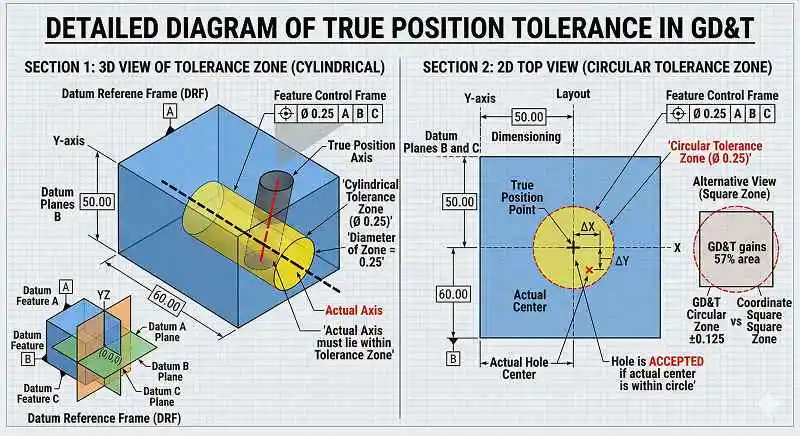
True position is a term used in Geometric Dimensioning and Tolerancing (GD&T) to define the exact, theoretically perfect location of a feature, such as a hole, slot, or pin, relative to a reference point known as a datum. Unlike simple dimensional tolerances, which only define the allowable variation in size, true position defines the location of a feature within a tolerance zone, often circular or cylindrical. This ensures that parts fit together as intended, even if they have slight variations in size or shape.
True position is critical in ensuring that multiple features align properly in an assembly, particularly in situations where precise interaction between components is required.
Learn more about: What are the steps of the design process
When to Use True Position in Design Thinking
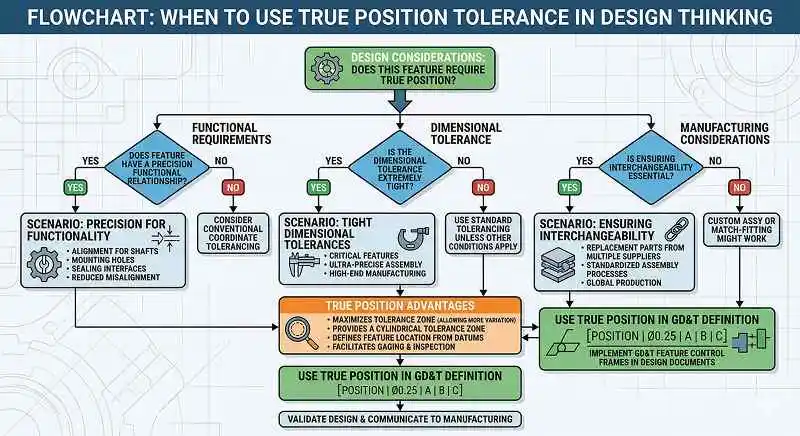
Understanding when to use true position is essential in design thinking. Here are some scenarios where this concept is vital:
1. When Precision is Crucial for Functionality
In designs where precise alignment of components is essential for functionality, true position becomes a key factor. For instance, when multiple holes need to align in an assembly, true position ensures that each hole is placed within an acceptable tolerance zone. This helps to avoid misalignment, which could otherwise lead to product failure or operational issues.
2. When Multiple Features Must Interact
For complex assemblies, such as automotive or aerospace components, multiple features often need to fit together seamlessly. True position allows you to specify not only the location but also the orientation of features relative to each other. This is crucial when parts from different manufacturers or production batches need to be assembled together without gaps or misalignments.
3. When Dealing with Tight Dimensional Tolerances
True position is particularly effective when there are tight dimensional tolerance requirements. It enables you to control the location of features with high precision, making sure the components fit properly even when size variations occur. This is especially important in industries where tight tolerances are a part of daily operations, such as the automotive, medical device, and aerospace sectors.
4. When Flexibility in Manufacturing is Needed
In high-volume production, true position offers flexibility without compromising accuracy. By utilizing Maximum Material Condition (MMC) or Least Material Condition (LMC) modifiers, designers can allow more tolerance when features are produced at their least material condition. This ensures that parts can still be manufactured within acceptable limits while providing flexibility for variation during production.
5. When Ensuring Interchangeability
True position guarantees that parts from different production runs or suppliers will fit together properly. This is essential in mass production, where parts must be interchangeable despite potential variations in the manufacturing process. Using true position helps to standardize feature locations, ensuring that parts will fit together correctly, improving the efficiency of assembly processes and reducing the chances of defects.
Integrating True Position into Your Design Workflow
To effectively integrate true position into your design thinking process, it’s important to follow best practices that help ensure accuracy and consistency across your designs. Here are some actionable tips:
1. Establish Clear Datums
Begin by defining reliable datums early in your design process. Datums serve as reference points for all features, ensuring consistency in feature location and orientation. A well-chosen datum system simplifies your true position application, making it easier for downstream teams to interpret and implement tolerances.
2. Define Tolerance Zones Thoughtfully
When specifying true position, it’s essential to consider how the tolerance zone reflects the functional needs of the part. Whether you’re designing a small component or a complex assembly, ensure that your tolerance zones reflect real-world use rather than theoretical ideals. This approach will result in more practical and manufacturable designs.
3. Leverage Material Condition Modifiers
Use MMC or LMC where appropriate to provide bonus tolerance. This allows for more flexibility in manufacturing while maintaining the desired fit and function. It’s particularly useful when designing for mass production, where small variations in material size are inevitable.
4. Use Control Frames and Basic Dimensions Clearly
Document your designs with clear control frames and basic dimensions to reduce ambiguity. This ensures that engineers, manufacturers, and quality control teams can easily interpret the design intent and apply the necessary tolerances correctly.
5. Validate Assumptions Through Prototyping
Before finalizing your design, validate your positional tolerance assumptions through prototyping or simulation. This helps to identify whether your tolerance zone is appropriate and whether the features will interact as intended during assembly.
6. Communicate Effectively Across Teams
Ensure that everyone involved in the design, manufacturing, and inspection processes understands the role of true position. Clear communication will minimize errors and misinterpretations, leading to smoother collaboration and more accurate results.
Why True Position Matters for Design Accuracy
True position is not just a technical specification—it’s a tool that ensures the accuracy and reliability of your designs. By accurately defining the location and orientation of features, true position reduces ambiguity and ensures that parts fit together as intended, even under varying manufacturing conditions. This is essential for delivering products that meet user needs and function as expected.
By integrating true position into your design thinking process, you ensure that your designs are both creative and technically sound. The balance between creativity and precision is what sets your work apart and enables you to deliver high-quality products consistently.
Final Thoughts
True position is a fundamental concept that every designer working with precision components should understand. By applying this concept strategically, you can ensure that your designs meet functional, manufacturing, and user requirements. Whether you’re designing a simple mechanical part or a complex product with many interacting features, true position allows you to control location and orientation with unparalleled precision.
To sum up, true position is not just for experts in geometric dimensioning and tolerancing (GD&T); it’s a versatile tool for anyone involved in the design and production of precise, reliable products. By understanding when to use true position in design thinking, you can create designs that are both innovative and manufacturable, helping to bring your ideas to life with accuracy and efficiency.