

Most businesses treat UX as “making the interface look nice,” but UX design strategy is the plan that connects every screen, flow, and feature directly to user needs and business goals—that’s why UX design strategy is important if you care about growth, ROI, and retention. In practice, it’s the difference between a product that looks good in a pitch deck and one that customers actually use, love, and pay for over time.
Learn more about :Why Small Business in Need of UX Research
TL;DR:
- UX design strategy aligns user needs with business outcomes so every design decision has a measurable purpose.
- Without it, teams ship pretty interfaces that underperform, waste budget, and frustrate users.
- A solid strategy lowers costs, speeds up delivery, and increases conversions and retention.
- You don’t need a big team to do this—you need a clear process, simple research, and shared priorities.
Key Takeaways
- Most companies underinvest in UX strategy, then overspend fixing avoidable UX problems later.
- A clear UX strategy turns user insights into business decisions, not just nicer UI.
- Strategic UX work consistently improves conversion rates, activation, and customer lifetime value.
- Early research, prototyping, and testing cut rework, scope creep, and development waste.
- Even small teams can build a lean UX strategy that guides roadmaps, experiments, and priorities.
What Is UX Design Strategy (And How Is It Different From Just “Good Design”)?
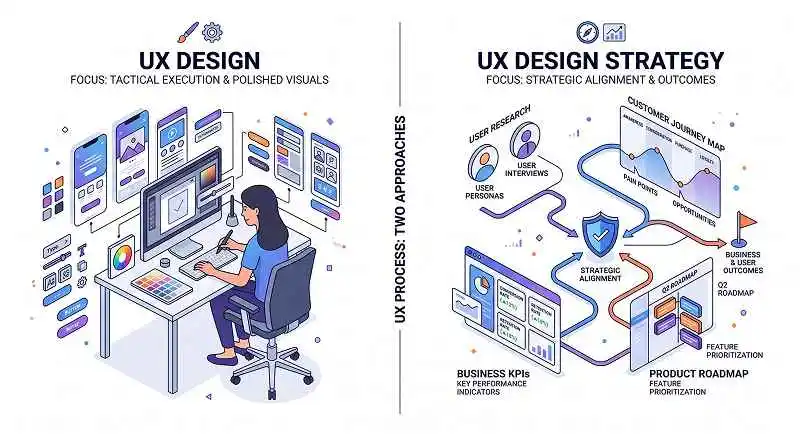
How do experts define UX design strategy?
UX design strategy is a practical, repeatable plan for how your product will deliver value to users in a way that also delivers value to the business. It connects three things: who your users are, what they’re trying to achieve, and which outcomes matter most to your company.
Based on experience, the key shift is this: design decisions stop being “what looks best” and become “what best moves our key metrics while solving a real user problem.” That means every screen, flow, and microcopy line is traceable back to a user need and a business goal. When this link is missing, you get attractive but ineffective products.
What’s the difference between UX design and UX design strategy?
UX design focuses on the execution—the flows, wireframes, visual design, content, and interactions people see and use. UX design strategy focuses on direction—what to build first, what to ignore, and how to measure success.
In practice, you can think of it like this:
- UX design = the house’s rooms, furniture, and decor.
- UX strategy = the blueprint, budget, and decision rules for what gets built and why.
According to industry research, products built with a clear strategy are far more likely to hit adoption and revenue targets because they avoid the trap of building “nice-to-have” features that don’t move the needle.
What common mistake do businesses make around UX strategy?
The most common mistake is assuming that hiring a designer or buying a design system automatically gives you a UX strategy. I’ve seen teams ship beautiful dashboards no one understands, onboarding flows no one completes, and feature-packed apps where users only touch 10% of the functionality.
Without a strategy, teams:
- Chase stakeholder requests instead of user needs.
- Redesign the same flows repeatedly without improving metrics.
- Make decisions based on opinions, not evidence.
Fixing this starts with explicitly defining how UX will support core business goals, then using that as a filter for every design and product decision.
What Are the Core Components of a Strong UX Design Strategy?
How does user research and empathy fit into UX strategy?
User research and empathy are the foundation of any serious UX strategy because they replace assumptions with evidence about what users actually do and need. This includes interviews, usability tests, surveys, and behavioral analytics that reveal pain points and motivations.
In practice, even five moderated usability tests can uncover issues that would cost weeks of engineering time if discovered after launch. Research shows that early-stage UX work can return anywhere from 2x to 10x in saved development costs. The goal isn’t academic research; it’s focused insight that directly informs what you prioritize.
Why must UX strategy align with business goals?
A UX strategy that doesn’t align with business goals quickly becomes a “nice-to-have” side project. Effective teams translate company objectives—like “increase self-serve revenue” or “reduce support tickets”—into UX objectives such as “improve checkout completion rate” or “simplify account setup.”
According to experts, this alignment is what makes executives actually care about UX work because they can see its impact on metrics they track. In my experience, when UX and business goals are clearly mapped, stakeholder debates shift from “I like this layout” to “Which version better supports our target KPI?”
How do information architecture and content strategy support UX?
Information architecture (IA) is how you structure and label content so users can find what they need quickly, while content strategy ensures the right messages appear at the right moments. Together, they are critical parts of UX strategy because they shape how users navigate and understand your product.
A common real-world example is a pricing page: clear IA groups plans logically, and smart content strategy explains differences in plain language. When done well, this reduces confusion, support tickets, and drop-offs. When done poorly, users bounce or choose the cheapest plan regardless of fit, hurting revenue.
Why is cross-functional collaboration essential?
Cross-functional collaboration ensures UX strategy is not created in a vacuum but co-owned by product, engineering, marketing, and customer support. This matters because each team has unique insights—support knows frequent complaints, sales hears objections, and engineering knows technical constraints.
In practice, the best UX strategies I’ve seen are created in workshops where teams align on user segments, key journeys, and success metrics. This reduces rework later because everyone understands the “why” behind design decisions. It also increases adoption of UX recommendations, since stakeholders helped shape them.
How do frameworks like the Double Diamond help?
Frameworks like the Double Diamond (Discover–Define–Develop–Deliver) give teams a simple, shared process for turning user insights into tested solutions. They formalize when you explore options and when you narrow down, which reduces the chaos of endless ideation or premature decisions.
Using a framework also helps small teams stay disciplined: you schedule time for discovery, definition, prototyping, and testing instead of jumping straight into hi-fi screens. Industry standards emphasize that structured processes like this consistently lead to better product–market fit and fewer failed releases.
Learn more about: UX Research Project for Nonprofit Organization
Why UX Design Strategy Is Important for Modern Businesses
How does UX strategy reduce costs and risk?
UX strategy reduces costs and risk by catching usability and value problems before they hit expensive development or the live product. By validating ideas early with prototypes and real users, you avoid building features no one wants or workflows that confuse customers.
Research shows that fixing a problem after development can cost 10–100x more than fixing it in the design phase. Based on experience, teams with a clear UX strategy spend less time firefighting after launch and more time iterating on what works. This not only saves budget but also protects brand reputation.
How does UX strategy impact growth and ROI?
A strong UX strategy directly impacts growth and ROI by improving critical funnel steps like sign-up, onboarding, activation, and checkout. Many studies have found that every dollar invested in UX can return multiple times in increased revenue and reduced churn.
In real projects, I’ve seen simple strategic changes—like clarifying value propositions in onboarding or simplifying a multi-step form—lift conversion rates by 10–30%. That’s why UX design strategy is important: it focuses effort where it produces measurable financial results, not just aesthetic improvements.
How does UX strategy align users, business, and technology?
UX strategy acts as a bridge between user needs, business objectives, and technical constraints, ensuring that what you build is desirable, viable, and feasible. Without this bridge, teams either build what’s easy for engineering, what leadership wants, or what looks trendy—none of which guarantee success.
According to experts, the most sustainable products are those where these three perspectives are balanced. A clear UX strategy documents trade-offs transparently, so teams understand why certain features ship now while others wait. This alignment reduces internal conflict and keeps roadmaps focused.
What Tangible Benefits Does UX Design Strategy Deliver?
How does UX strategy cut down costs and speed things up?
UX strategy cuts down costs and speeds up delivery by focusing teams on the right problems and using low-fidelity experiments to test solutions quickly. Instead of coding first and fixing later, you prototype, test, and iterate before committing engineering time.
A common real-world example is redesigning a signup flow: with a strategy, you test two or three versions with clickable prototypes in a week, then implement the winner. Without one, you might spend a month building the wrong flow, then another month fixing it. Over time, this difference compounds across the entire product.
How does UX strategy keep customers happy (and loyal)?
UX strategy keeps customers happy and loyal by ensuring the product consistently reduces their friction and helps them achieve their goals faster. Happy users come back more often, explore more features, and are more likely to recommend your product.
Research shows that improved usability and satisfaction correlate strongly with higher retention and customer lifetime value. In practice, when you systematically remove friction from key journeys—like support, billing, or account management—you see fewer cancellations and more positive reviews, which fuels organic growth.
How does UX strategy boost conversions and revenue?
UX strategy boosts conversions and revenue by deliberately optimizing high-impact touchpoints, such as landing pages, pricing, onboarding, and checkout. Instead of random A/B tests, you run experiments informed by user insights and business priorities.
For example, if your strategy identifies “first value moment within 5 minutes” as a key metric, you redesign onboarding to get users there faster. Many SaaS products that take this approach see meaningful gains in trial-to-paid conversion. The mechanism is simple: when users quickly see value and understand next steps, they’re far more likely to pay and stay.
How does UX strategy fuel innovation and future-proof your brand?
UX strategy fuels innovation by creating a continuous loop of learning from users, testing ideas, and scaling what works. Rather than guessing future trends, you observe emerging behaviors and pain points directly in your user base.
Worth noting, this doesn’t always mean flashy features; often, innovation is a smarter workflow, better automation, or more personalized content. Brands that treat UX as a strategic engine stay relevant longer because they adapt to changing user expectations before competitors do.
How does UX strategy help teams make smarter decisions?
UX strategy helps teams make smarter decisions by providing clear decision criteria: user impact, business impact, and evidence from research or data. This reduces design-by-committee and HiPPO (Highest Paid Person’s Opinion) decisions.
In practice, you can rank ideas on a simple impact/effort matrix grounded in your UX and business goals. When stakeholders ask for new features, you evaluate them against your strategy instead of reacting emotionally. Over time, this builds a culture of evidence-based decisions, which is one of the most valuable outcomes of strategic UX work.
How Can AI and Modern Tools Supercharge Your UX Design Strategy?
How can AI improve user research and insights?
AI can supercharge UX strategy by processing large volumes of qualitative and quantitative data to surface patterns faster than humans alone. Tools can cluster feedback, detect recurring themes in support tickets, and highlight friction points in user journeys.
Based on experience, this doesn’t replace talking to users, but it does make it easier to prioritize what to investigate. For example, AI-powered analytics can flag where users drop off most often, so you know exactly which flows to test and redesign first. This makes your strategy more data-informed and less guesswork-driven.
How can AI enable personalization and experimentation?
AI enables smarter personalization by dynamically adapting content, recommendations, or flows based on user behavior and attributes. When guided by a sound UX strategy, this personalization focuses on helping users reach their goals faster, not just pushing more features.
Modern experimentation platforms also use machine learning to optimize variants in real time. According to industry standards, combining UX strategy with these tools lets you run more targeted experiments, learn faster, and avoid overfitting to vanity metrics. The result is a product that feels tailored and continuously improving.
What are the limits and caveats of using AI in UX?
AI is powerful, but it’s not a substitute for understanding humans; it’s an amplifier for teams that already have a clear UX strategy. If your goals are vague or misaligned, AI will simply help you go in the wrong direction faster.
Worth noting, you must be careful with data privacy, bias, and over-automation. Blindly trusting AI-generated interfaces or content can harm trust if they feel off-brand or insensitive. The most effective teams use AI as a collaborator: it handles the heavy lifting of analysis and optimization, while humans own ethical judgment, empathy, and strategic direction.
In the end, the real reason why UX design strategy is important is simple: it turns UX from a cosmetic expense into a core growth engine that links user happiness with business performance. You avoid building the wrong things, you improve what matters most, and you create experiences that users actually stick with.
You don’t need a giant budget to start. Begin with three concrete steps: talk to five users, map one key journey to a business metric, and run one small experiment to improve it. Do that consistently, and you’ll fix the UX strategy mistake most businesses make—reactive design with no clear direction—and replace it with a focused, measurable path to better products and better results.
Learn more about: How to Become a UX Researcher