

A UX researcher studies how real people use products and turns those observations into evidence-based recommendations for better design and business decisions. If you’re wondering how to become a UX researcher from a non-design or non-tech background, this guide walks you through what the role is, why it matters, and the exact steps to break in.
Learn more about: UX Research Project for Nonprofit Organization
TL;DR – Key takeaways
- UX researchers investigate user needs, behaviors, and pain points to guide product and service decisions.
- Day-to-day work includes planning studies, interviewing users, running usability tests, and turning data into clear insights.
- Demand is strong as more companies compete on customer experience and want to reduce the risk of building the wrong features.
- You do not need a design degree or coding background; skills in communication, analysis, and empathy transfer very well.
- A structured learning path with real projects and a portfolio is the fastest way to transition into this career.
What Is UX Research and Why Does It Matter?
Understanding the core idea of UX research
UX research is the practice of systematically studying users to understand who they are, what they need, and how they interact with a product or service. In practice, that means asking questions like: Who are our users? What are they trying to accomplish? Where are they getting stuck or frustrated? Based on experience, the most successful teams use research not just once, but throughout the product life cycle.
How UX research connects people and products
At its heart, UX research connects human behavior with business and design decisions. Researchers observe and measure how people actually behave, rather than relying on internal assumptions or opinions. According to multiple industry studies, companies that invest in user research tend to ship products faster and waste less budget on unused features. The result is a better fit between what a product offers and what users are willing to adopt, pay for, and recommend.
Why UX research is critical for modern businesses
UX research helps companies reduce risk, prioritize the right problems, and avoid expensive redesigns after launch. A common real-world example is uncovering that users never find a “premium” feature because it’s buried in the interface, leading to poor revenue despite strong engineering. When research surfaces that issue early, teams can fix the navigation instead of rebuilding the entire product. That is why more organizations—startups and enterprises alike—are hiring researchers as a core part of their product strategy.
What Does a UX Researcher Actually Do Day to Day?
Typical responsibilities of a UX researcher
A UX researcher plans and runs studies to answer specific questions about users and products. On a typical project, they might start by meeting with product managers and designers to clarify goals and define research questions. Then they choose appropriate methods—such as interviews, usability tests, or surveys—and design a research plan that fits the timeline and budget.
Key tasks and responsibilities
Based on experience leading research in product teams, the core responsibilities usually include:
- Collaborating with stakeholders to define research goals and success metrics.
- Selecting appropriate methods (interviews, usability tests, surveys, field studies).
- Creating research plans, discussion guides, and test scripts.
- Recruiting representative participants and managing incentives.
- Moderating sessions and taking structured notes or recordings.
- Analyzing qualitative and quantitative data to identify patterns and themes.
- Packaging insights into clear stories, reports, and presentations.
- Advocating for user needs in roadmap, design, and strategy discussions.
How UX researchers work with other roles
UX researchers rarely work in isolation; they sit at the intersection of design, product, data, and engineering. They might pair with a UX designer to test early wireframes, or with a data analyst to combine behavioral analytics with interview findings. According to experts in mature product organizations, the most trusted researchers are those who speak the language of each discipline and turn insights into actionable recommendations, not just long reports. In practice, this means joining design critiques, backlog grooming sessions, and strategy workshops as the “voice of the user.”
What Skills and Tools Do You Need (Without a Design or Tech Degree)?
Core skills that matter more than your degree
To move into this field without a formal design or technical background, focus on building a mix of soft and hard skills. The most important soft skills are curiosity, empathy, clear communication, and critical thinking. Many career switchers from psychology, marketing, education, and customer support already have these strengths; they just need to reframe them in a research context.
Practical research and collaboration skills
On the more technical side, you’ll need to learn how to plan studies, ask unbiased questions, and analyze data. Industry standards emphasize triangulation—combining multiple methods—to get a fuller picture of user behavior. Useful skills include:
- User interviews and contextual inquiry
- Usability testing (remote and in-person)
- Survey design and basic statistics
- Affinity mapping and thematic analysis
- Creating personas, journey maps, and insight summaries
- Presenting findings to non-research audiences
- Basic familiarity with product metrics and A/B testing
Common tools used by UX researchers
Most UX research tools are accessible, even for beginners without a tech background. In practice, many teams use simple tools like Zoom, Google Docs, and spreadsheets for planning, note-taking, and analysis. As you advance, you might work with specialized platforms for participant recruitment, remote testing, and survey distribution, as well as whiteboarding tools like Miro or FigJam. The key is not mastering every tool, but understanding the underlying methods so you can adapt to whatever stack your future employer uses.
How to Become a UX Researcher From a Non-Tech Background?
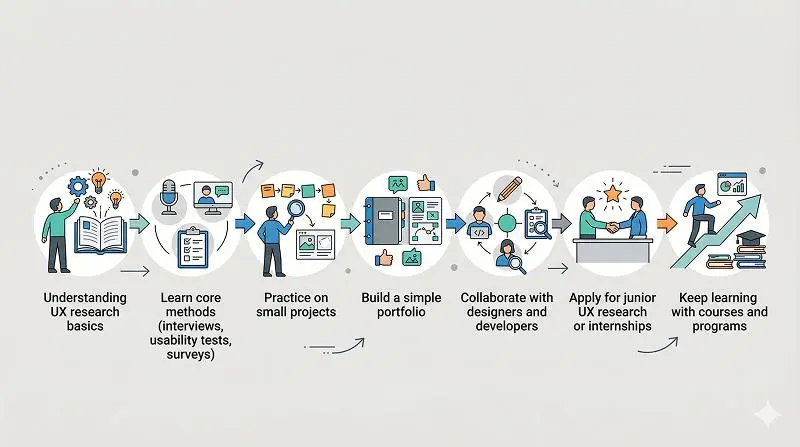
Step-by-step path to transition into UX research
The clearest path for someone without a design or coding degree is to combine structured learning, hands-on practice, and a focused portfolio. Start by learning the fundamentals of UX, research methods, and product development so you understand how your work will be used. Then, apply those concepts in small projects—redesigning a local business site, testing a nonprofit’s app, or running research on a side project—to build real examples of your skills.
Building a portfolio and gaining experience
Hiring managers care far more about how you think and work than about your academic major. A strong entry-level portfolio shows 3–5 projects with clear problem statements, research plans, samples of your materials (discussion guides, test scripts), raw findings, and the decisions your work influenced. Based on experience mentoring career switchers, even self-initiated projects can be compelling if they follow realistic constraints and demonstrate solid reasoning. Volunteering for nonprofits, student organizations, or small startups is often the fastest way to get that real-world context.
Learning paths and structured programs
If you prefer a guided route, a dedicated learning path can compress years of trial and error into a few focused months. Many successful researchers have completed online programs that combine theory, templates, and feedback on real projects. When you evaluate options, look for curricula that emphasize user-centered methods, mixed research techniques, and portfolio-ready case studies rather than just theory. This combination gives you both the confidence and evidence you need to position yourself as a serious candidate.
Lear more about: What are The Steps of The Design Process
How Can a Dedicated UX Research Program Help You Start Faster?
Introducing the User Experience Research Launchpad
A structured program like the User Experience Research Launchpad can give you a clear roadmap when you’re not coming from design or tech. This type of online, part-time program is typically designed to be completed in about 3–4 months alongside a full-time job. In practice, it walks you through the entire research process multiple times so the methods become second nature, not just something you read about.
Skills you can expect to learn in such a program
A well-designed curriculum should help you build end-to-end competence, including:
- UX fundamentals and user-centered design
- Research planning and stakeholder alignment
- Qualitative methods: interviews, usability testing, field studies
- Quantitative basics: surveys, simple statistics, A/B testing concepts
- Participant recruiting and screening
- Note-taking frameworks and analysis techniques
- Personas, journey mapping, and opportunity framing
- Communicating insights and storytelling with data
- Portfolio case study creation and presentation skills
- Job search strategy and interview preparation for research roles
Based on experience, learners who repeatedly practice these skills on real or realistic projects feel much more confident in interviews and whiteboard challenges.
Social proof, flexibility, and next steps
Thousands of learners worldwide have used similar programs to move from fields like teaching, customer success, and academia into UX research roles. Average completion times are often under six months, with flexible, self-paced modules so you can learn around your current responsibilities. If you are serious about this transition, treating your learning like a part-time job—consistent hours each week, deadlines, and feedback—will dramatically increase your odds of landing that first role.
Conclusion: Your Next Steps Toward a UX Research Career
Why this path is realistic for non-designers
Becoming a researcher in UX is absolutely realistic even if you do not have a design degree, coding skills, or a traditional tech background. Many of the best researchers I have worked with started in psychology, anthropology, customer support, or operations and brought deep empathy and analytical thinking with them. The difference-maker is not your past title, but your willingness to learn research methods, practice them in real contexts, and communicate your impact clearly.
Turning interest into action
If you are serious about becoming a UX researcher, the next steps are simple. Learn the fundamentals, run small real-world studies, and build a focused portfolio that shows your thinking process. Avoid collecting certificates without applying what you learn. Most employers care more about your problem-solving skills than course completion badges. Candidates who can confidently explain two or three structured projects often stand out, even for junior roles.
A practical call to action
Start with a product you already use every day. Run a small research project around it. Interview a few users, conduct a short usability test, and summarize your findings clearly. Turn that work into your first portfolio case study. After that, consider joining a structured program like User Experience Research Launchpad to deepen your skills and create stronger projects. With consistent practice over several months, you can build a convincing career-change story and confidently apply for your first UX research role.
Learn more about: Why User Experience Design is Important